

Hi there,
Every AI initiative has someone who pushes back. You know who they are. They ask the uncomfortable questions in the rollout meeting. They point out the gaps in the pilot data. They do not attend the optional training session.
The instinct is to overcome the resistance. To bring them around. To wait them out.
But what if they are seeing something the dashboard cannot show you?
If this is your first article in this series, the framework behind it is here. I have been writing about the friction points that block AI adoption, from misdiagnosis to compliance theatre. This week is about the friction point that talks back.
Three types of resistance. Only one is a problem.
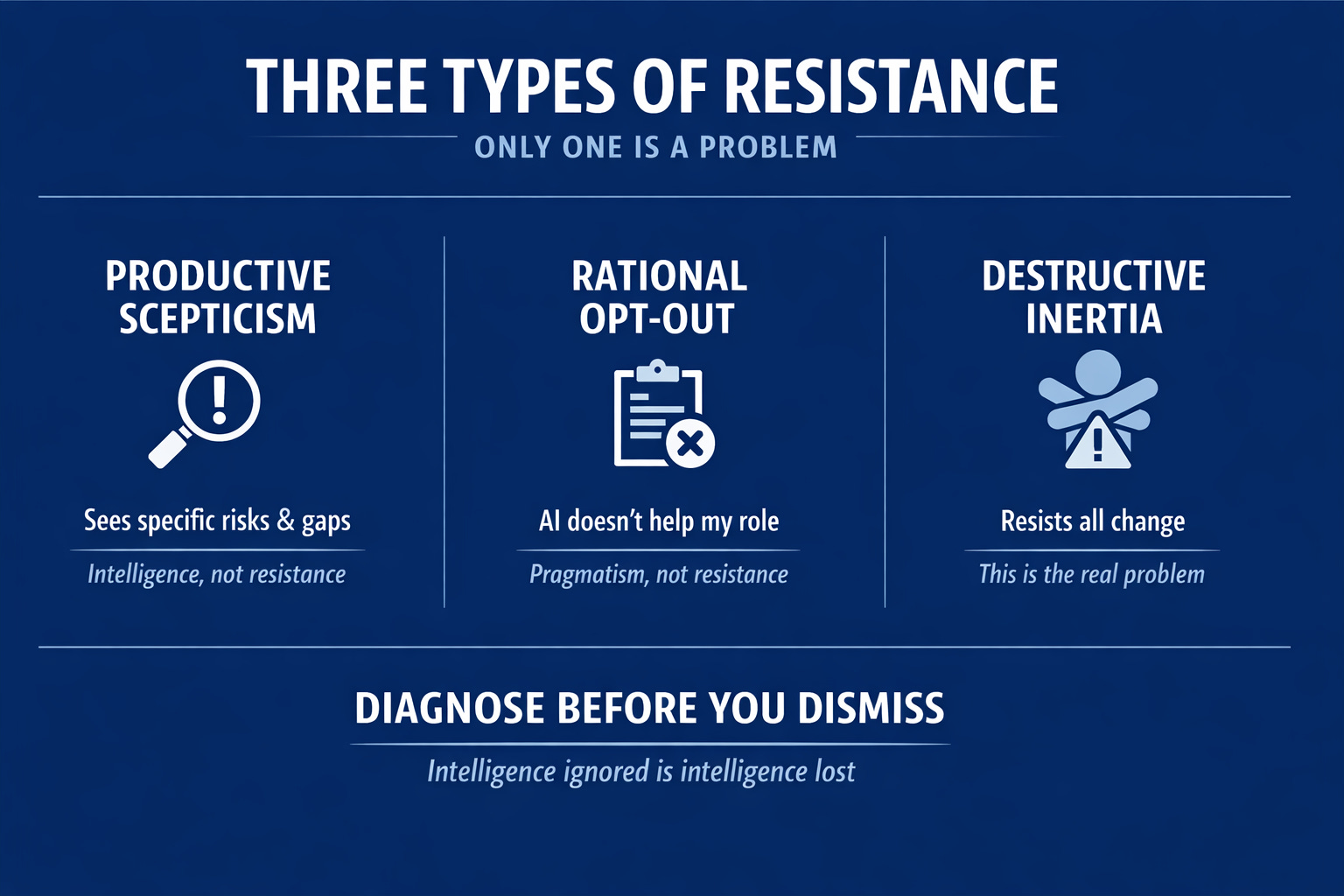
Not all scepticism is the same. Most organisations call it “resistance” and try to manage it away. That is a mistake. It costs you the most valuable data your initiative will produce.
There are three types of resistance, and they require three entirely different responses.
The first is productive scepticism. The person sees a specific risk: implementation gaps, workflow disruption, data quality concerns, the gap between what was promised and what is being delivered. This is not resistance. It is intelligence. The productive sceptic is naming the things nobody else is willing to surface. They are doing the work the dashboard cannot do.
The second is rational opt-out. The person has calculated that AI does not help with their specific work. They may be right. Not every role benefits equally from current AI tools. A financial analyst whose work depends on proprietary data sources may find that AI adds a step without adding value. Call it pragmatism, not resistance. And the organisation that forces adoption on someone whose opt-out is rational creates compliance theatre, the exact pattern I wrote about last week.
The third is destructive inertia. The person is resisting all change, not just AI. They resisted the last system migration. They resisted the process redesign before that. This is the only type that is a problem. And it is rarer than leaders assume.
Most leaders never run the diagnostic. They treat all three as type three because it is the easiest to dismiss. “They are resistant to change.” That label saves the leader from having to listen. It also ensures that productive scepticism and rational opt-out are ignored. The intelligence is lost. The risks go unexamined. And the initiative proceeds on assumptions that have not been tested.
In the 5C framework, this is Credibility friction. The sceptic sees a gap between what was promised and what is delivered. It is also Consequences friction: they are naming what nobody else will say about what happens to roles, to quality, to the work itself. What happens when the tool gets it wrong and they are accountable. And it is Control friction: they were not involved in decisions that affect their work. These are not objections. They are questions the initiative should have answered and has not.
The most valuable conversation is not with the enthusiast. It is with the sceptic. The enthusiast tells you what you want to hear. The sceptic tells you what you need to hear. Are you listening? Or waiting for them to come around?
The cost of not listening
Dismissing a productive sceptic has a double cost. First, you lose the intelligence they carry. The risks they see are real. The gaps they name exist. Ignoring them does not make the risks disappear. It makes the risks invisible until they surface as failures.
Second, you create an adversary. The sceptic who is ignored does not disappear. They become more entrenched. And the team watches how the organisation treats dissent. If the person who raised legitimate concerns was labelled as resistant? Excluded from the conversation? The rest of the team draws a conclusion. The conclusion is: do not be honest. Perform compliance instead. The connection between dismissed scepticism and the compliance theatre I described last week is not a coincidence. It is a mechanism.
The Sceptic Interview Matrix below gives you the branching conversation for each type of sceptic, with different questions, follow-ups, and next steps. The Risk Mapping Template turns what they tell you into the action plan your initiative is currently missing. Without them, you have a taxonomy of sceptics with no way to act on it. Both are available to paid subscribers, along with the 5C Decision Tree, the Leader Selection Criteria, the Pilot-to-Practice Checklist, the Meeting Rhythm Audit, the Compliance Theatre Diagnostic, and the full 5C playbook archive.
Identifying which type you have
The distinction is simpler than it seems. Three questions will tell you.
Can they name a specific risk? Not a vague complaint. A specific gap, a specific concern, a specific scenario where the initiative is making an assumption it has not tested. If yes, you are looking at productive scepticism. The risk they name is worth more than the dashboard they are ignoring.
Can they explain why AI does not help their specific work? Not “I do not like change.” A specific explanation of what they tried, what happened, and why it did not improve their output. If yes, you are looking at rational opt-out. Their explanation may reveal a genuine limitation that applies to other roles too.
Do they resist all change, not just AI? Think about the last three organisational changes. Were they resistant to all of them? If yes, the pattern is positional, not analytical. This is destructive inertia. But it is rarer than you think. Check before you assume.
Find the sceptic you identified while reading this. Ask them one question: “What risk are we ignoring?” Not “What is your concern?” The framing matters. “Concern” sounds like a feeling to be managed. “Risk” sounds like intelligence to be captured. Ask the question. Do not defend. Write down what they say.
You know which type of sceptic you are dealing with. The Sceptic Interview Matrix gives you the branching conversation for each type. The Risk Mapping Template turns what they tell you into an action plan. Both tools plus six weeks of diagnostics and the full 5C playbook archive are waiting for paid subscribers.
