

You identified the friction point. You invested months of effort, budget, and political capital in addressing it. Training programmes were commissioned. Tools were deployed. Change leads were hired. AI adoption did not shift.
The problem was never the one you diagnosed. It was the one your role trained you not to notice. And the pattern that led you there is so consistent, and so costly, that it deserves a name: misdiagnosis by default.
When an AI adoption initiative stalls, the instinct is to diagnose the problem quickly and act. That instinct is sound. The problem is where the diagnosis lands.
Technical leaders tend to see capability gaps. Their teams do not know how to use the tools, so the response is training, upskilling, centres of excellence. Communications leaders tend to see clarity gaps. The message has not landed, so the response is more internal comms, town halls, updated intranet pages. People leaders tend to see control gaps. The team feels unsettled, so the response is listening sessions, wellbeing check-ins, culture initiatives. Finance leaders tend to see consequence gaps. There is no incentive structure, so the response is KPIs, accountability frameworks, performance metrics tied to adoption.
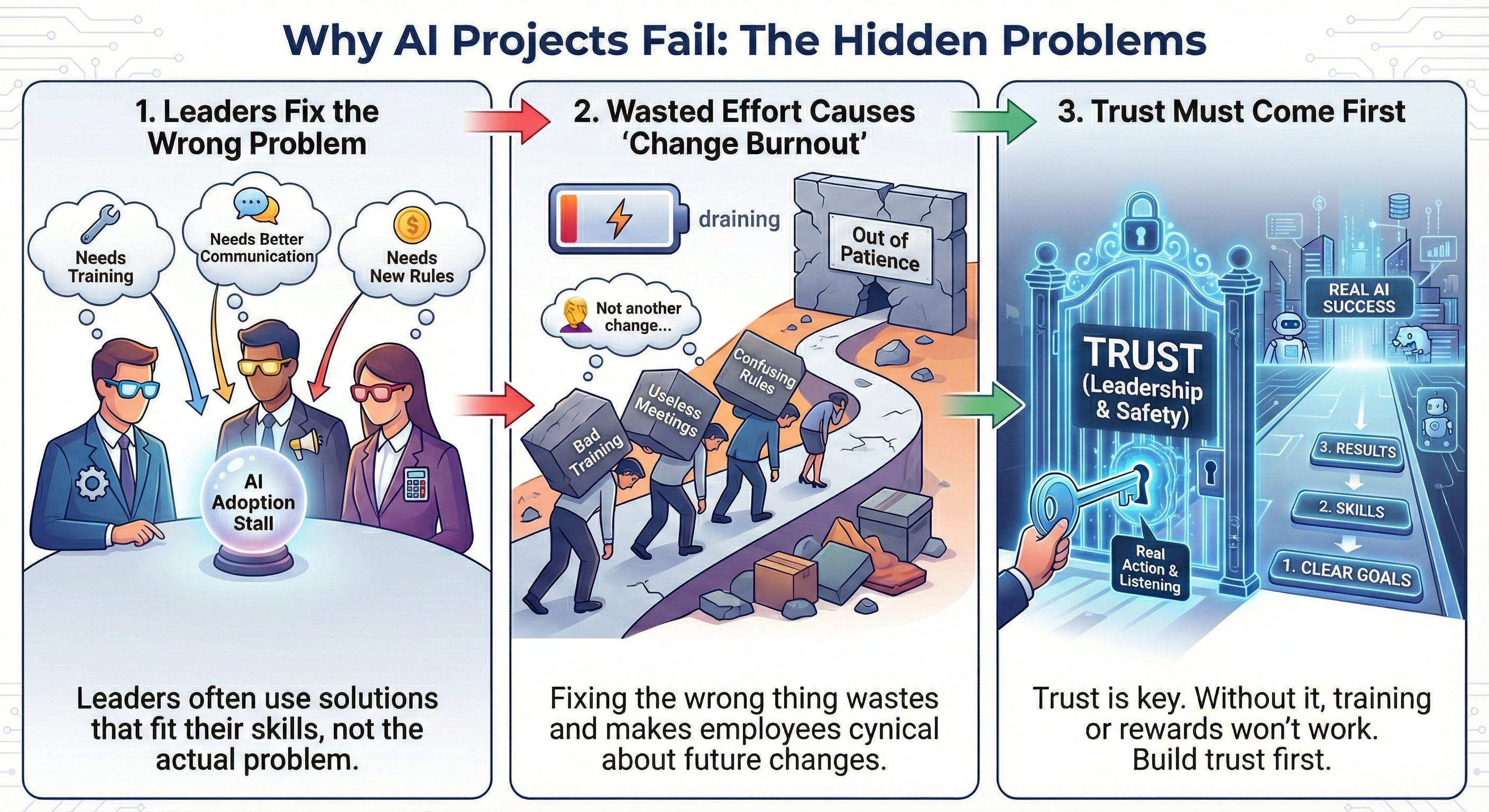
Each of these diagnoses may be accurate. But in most cases, the leader has not diagnosed the actual problem. They have diagnosed the problem that matches their expertise. They have defaulted, not diagnosed.
This is not a criticism. It is how human cognition works. When you have spent a career developing a particular lens, that lens becomes the first one you reach for. A technical leader does not see credibility problems because credibility is not their domain. A communications leader does not see control problems because control sits outside their function. The diagnosis is shaped by the diagnoser, not the situation.
I wrote about the five friction points that block AI adoption in the article that introduced the 5C Adoption Friction Model: Clarity, Capability, Credibility, Control, and Consequences. Each is a genuine category of friction. The model is not the problem. The problem is which one you start with.
In twelve years of delivering transformation projects across financial services, I have watched this pattern repeat more times than I can count. A leader identifies the friction point that matches their skillset and starts there. It is not carelessness. It is human nature. And it is the most expensive mistake in AI adoption.
The cost is not limited to the wasted investment. When a leader spends six months addressing the wrong friction point, they consume the organisation’s patience. The team participated in training that did not solve their actual concern. They attended town halls that did not address what was really holding them back. By the time the real friction point is identified, the organisation has developed a tolerance for initiative fatigue. The next intervention, even if correctly targeted, faces a harder audience.
Diagnosing the primary friction point from inside is like trying to see your own blind spot. The AI Change Leadership Intensive ($500, 90 minutes) gives you an outside perspective: your primary friction point, and the moves most likely to shift adoption. If you do not leave with at least one actionable insight, I will refund you in full.
The question, then, is how to diagnose without defaulting. Because the default is not random. It is predictable. And if you can see the pattern, you can interrupt it.
There is a triage process that narrows the field. It requires two questions, not five. It will not give you a definitive answer in isolation, but it will eliminate the wrong starting points. And eliminating the wrong starting points is more than half the work.
The first question separates the knowledge problems from the trust problems. Is the friction that people do not know what to do, or that they do not know how to do it? If the answer is “what to do,” you are in Clarity territory. If “how to do it,” you are in Capability territory. If the answer feels like “both,” use a forcing function: if you had to bet your next quarter’s budget on one, which would it be? That bet reveals which friction you actually believe is primary. If the answer is neither, if your team knows what to do and broadly knows how to do it, then the friction sits elsewhere.
The second question separates the belief problems from the safety problems. Does your team trust the direction? Do they believe leadership is committed to this, that it will not quietly disappear in three months? If the answer is uncertain, you are in Credibility territory. Do they feel threatened by the change, seeing AI as a risk to their role, their autonomy, or their standing? If so, you are in Control territory.
These two questions will not resolve the diagnosis entirely. But they will narrow your field from five possibilities to two. That is a significant reduction in wasted effort, and it changes the quality of every conversation you have from this point forward.
If neither knowledge nor trust nor safety explains the stall, the remaining possibility is Consequences. There is no cost to waiting and no reward for moving. The rational response, in that environment, is to do nothing.
Think about your current initiative. Which friction point did you diagnose first? Now ask yourself: did you diagnose it, or did you default to it?
Below: the 5C Diagnostic Decision Tree. Walk your leadership team through it in your next meeting and you will know which friction point is primary before you leave the room. Paid subscribers also have access to five playbooks, conversation scripts, and audit templates across all five friction points.