

Your AI pilot worked. The team used the tools. The metrics moved. The executive sponsor presented the results to the board. Everyone agreed: this is proof of concept.
You are right to be pleased. You are wrong to be confident.
I have been writing about the friction points that block AI adoption and why leaders almost always start with the wrong one. Last week was about the wrong person leading the initiative. This week is about what happens after the good news.
The pilot succeeded. Of course it did. It was designed to.
Why pilots succeed
Think about how your pilot was set up. Every condition was designed to produce a positive result. And every one of those conditions will disappear when you try to scale.
I have seen this pattern in every technology change programme I have worked on. The pilot is designed to succeed. It has resources, attention, and a team that was selected because they were willing. Scale has none of those advantages. And nobody plans for that gap.
The pilot proved something real. It proved that the technology works, that people can learn it, that under the right conditions AI produces results. In the language of the 5C Adoption Friction Model, that is Capability. One friction point out of five.
What about the other four? Whether the broader organisation trusts the people behind this initiative. Whether people feel they have agency in how AI changes their work. What happens to roles and career paths when AI is no longer a pilot but a permanent fixture. The pilot team never needed to worry about any of that. They were willing. They had support. They were protected from the questions that scale will force into the open.
And here is what makes this pattern so persistent. The pilot’s success does not just leave those questions unanswered. It makes them harder to ask.
“But it worked.”
That is what you hear. Every time. Someone raises a concern about trust, or control, or what happens to their role, and they get pointed at the dashboard. The metrics. The board presentation. Their question does not get answered. It gets overruled by numbers from a group of people who look nothing like the people you are about to roll this out to.
This is the same misdiagnosis pattern from Week 1, wearing a different face. The leader looks at the pilot and sees a Capability success. They assume the remaining friction will resolve itself. It will not. It never does. And the pilot’s success is the reason nobody notices until the scale attempt has already stalled.
The cost you are not calculating
The cost of a failed scale attempt after a successful pilot is not the money. It is the precedent.
“We tried AI. It did not stick.”
That sentence, spoken once in a leadership meeting, can set adoption back by a year. It becomes the organisational narrative. It is the sentence your sceptics will quote for the next three budget cycles. It is the sentence your middle managers will use, quietly, to justify not prioritising AI in their teams.
A failed scale attempt after a successful pilot is worse than no pilot at all.
Without the pilot, the organisation has no opinion. After a failed scale, the organisation has a conclusion: we gave it a fair go, and it did not work. The reality is different. You gave the pilot a fair go. You never planned the transition. But the nuance will not survive the next quarterly review.
The pilot’s success becomes the alibi for the scale’s failure.
If your pilot succeeded and you are not sure whether that success will transfer, that gap is exactly what the AI Change Leadership Intensive is built for. $500, 90 minutes, and you will leave knowing whether your pilot data supports scale or masks the friction that scale will expose. If you do not leave with at least one actionable insight, I will refund you in full.
Two questions before you scale
You have the pilot results. The pressure to scale is real. Before you commit, start here.
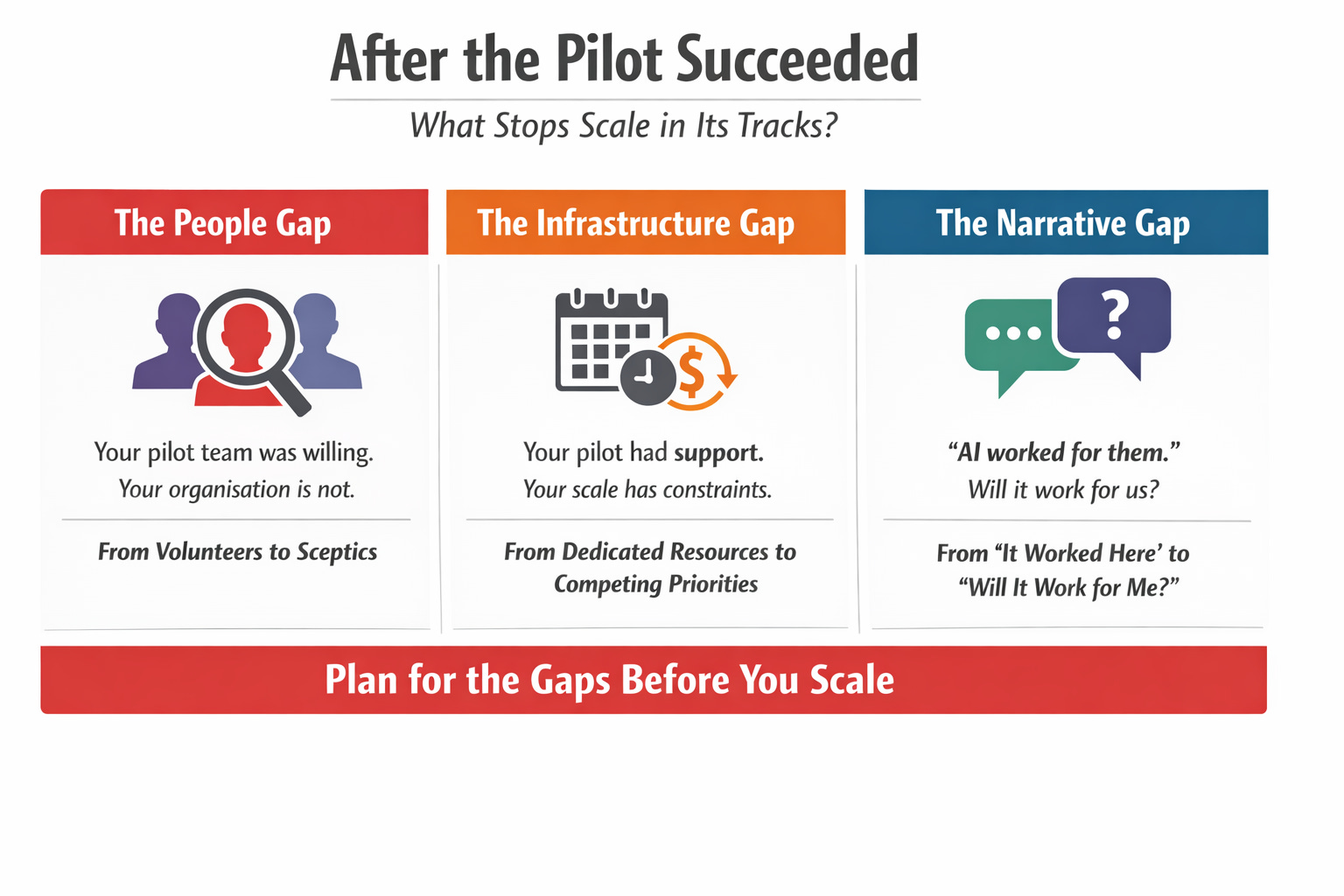
Was your pilot team self-selected or representative? If the team volunteered, or if they were hand-picked for their enthusiasm, their success tells you about willing adopters. It tells you nothing about your organisation. Scale requires the people who did not volunteer. The people who are busy, sceptical, or simply focused on other priorities. If your pilot did not include them, it did not test what scale will encounter.
Did your pilot have dedicated resources that will not exist at scale? Protected time. A dedicated budget. Executive air cover. A project manager whose only job was making it work. Ask yourself which of those will exist when you roll out to three hundred people across four departments. If the answer is fewer than you had, the conditions that produced your pilot’s success no longer apply. And you are planning as though they do.
There is a third question. It is the most important one, and it is the one most leaders have never asked about their pilot. It is in the paid section below, along with the three gaps between your pilot and your scale, and the Pilot-to-Practice Transition Checklist that tells you what order to close them in.
Your pilot succeeded under conditions that no longer exist. Did you plan for that, or did you assume the conditions would follow?
You know the pilot does not predict scale. But you do not yet know which gap will stall your rollout first. Below: the third diagnostic question, the three gaps between your pilot and your scale, and the Pilot-to-Practice Transition Checklist. This is your third new diagnostic tool. Combined with the Decision Tree, the Leader Selection Criteria, and the five 5C playbooks already in the library, you now have a complete diagnostic and action toolkit for your first quarter.