

There is someone on your team who volunteered for this. They were the first to install the tools. First to attend the training. First to send around the articles, the podcasts, the LinkedIn posts about what AI can do.
You were grateful. You should not have been.
Last week I wrote about the five friction points that block AI adoption and why leaders almost always diagnose the wrong one first. This week is about the person you appointed to fix it.
Every organisation has one. The enthusiast. The champion. The person who puts their hand up before anyone else and says, “I will drive this.” They are visible. They are energetic. And in most of the transformation programmes I have worked on, they are the person the rest of the team quietly resents.
That resentment is the signal most leaders miss.
The gap between enthusiasm and influence
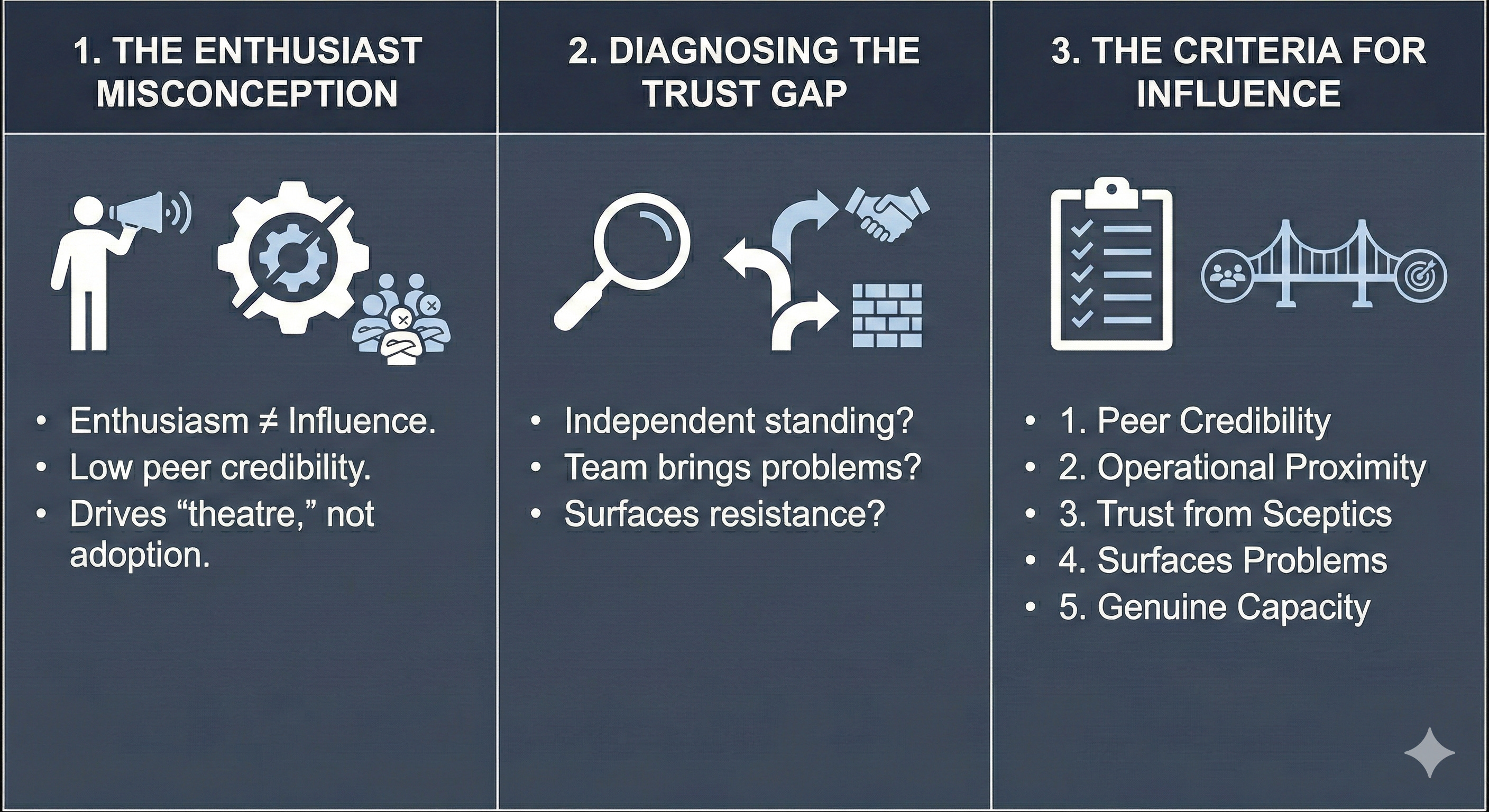
Here is the problem. Enthusiasm is visible. Influence is structural. They are different qualities. They do not correlate the way you think they do.
When a leader looks for someone to drive AI adoption, they reach for the person who is already moving. It makes sense. You have a team of people who are cautious, sceptical, or simply busy, and here is someone who is keen. Of course you give them the role.
But willingness to lead is not the same as ability to lead. The enthusiast volunteered because they are excited about the technology. The team needs to be led by someone they trust. Those are different things.
The enthusiastic champion often has lower peer credibility precisely because of their enthusiasm. The rest of the team watches someone who seems more interested in AI than in the actual work. They see someone who has opinions about everyone’s workflow but has not demonstrated that they understand the pressures, the constraints, the reality of what it takes to get through a Tuesday.
And so the team does what teams always do when they do not trust the messenger. They go through the motions. They attend the training. They activate the tools. They tick the boxes. And nothing changes.
The champion reports progress. Tool activation is up. Training completion is strong. The dashboard looks healthy.
The leader sees momentum. The team sees theatre.
Every transformation programme I have worked on has had this person. The volunteer. The enthusiast. And in most cases, the person the rest of the team quietly resents. Enthusiasm without influence does not drive adoption. It drives compliance theatre.
This is the same misdiagnosis pattern I described last week, wearing a different face. The leader looks at the stall and sees a Capability gap: the team needs more training, more support, more resources. But the actual friction is Credibility. The team does not distrust AI. They distrust the person representing it. And no amount of training will fix a trust problem.
The cost compounds. Every month the wrong champion is in place, the team’s association between “AI adoption” and “that person” deepens. By the time the leader recognises the problem, AI adoption has become culturally linked to the champion’s reputation. Replacing the champion does not reset the association. It just removes the most visible symptom.
If you are not sure whether your champion is helping or hurting, that uncertainty is the signal. The AI Change Leadership Intensive ($500, 90 minutes) gives you an outside perspective. If you do not leave with at least one actionable insight, I will refund you in full.
Three questions that reveal the answer
You probably have someone in mind already. Here is how to move from instinct to diagnosis.
Does this person have standing independent of the initiative? If you removed AI adoption from their role tomorrow, would their colleagues still describe them as influential? If the answer is no, their influence is positional. It comes from the role, not from them. And positional influence does not transfer.
Does the team bring problems to this person, or does this person bring solutions to the team? This is the direction of trust. Champions who push solutions without being asked are experienced as salespeople, not colleagues. The people who drive genuine adoption are the ones others already go to when something is not working.
Does this person represent the team’s concerns accurately to leadership, or do they filter out resistance to maintain momentum? A champion who reports only progress is not a bridge between leadership and the team. They are a wall.
If you completed the 5C Diagnostic Decision Tree from last week, these three questions sit in the Credibility branch. This is where that branch leads in practice.
If the answer to any of these questions is unfavourable, the champion is not the problem. Your selection process is the problem. You optimised for enthusiasm. You should have optimised for trust.
Think about the person you chose. You gave them the role because they were keen. Did you check whether the team trusts them?
Below: the AI Adoption Leader Selection Criteria and a conversation script for redirecting an enthusiastic champion without demoralising them. Use the criteria in your next planning session.