

New to the series? Begin with Week 1: You Are Probably Solving the Wrong Problem. Or read Your AI Training Isn’t Working. Here’s Why. for context on the five adoption friction points.
Last week explored why your AI sceptics are right about more than you think. This week, the lens turns inward.
The person stalling adoption approved it
This is the hardest conversation in any transformation programme.
The pattern is recognisable. Budget approved. Tools selected. Training delivered. Three months later, the team is barely using any of it. The leader asks why. The answer is usually in the leader’s own calendar, but nobody will say that out loud.
The leader who commissioned the initiative is often the person whose behaviour is stalling it. Not through malice. Through signals they cannot see. Signals are not the only friction point, but they are the one leaders have the most direct control over, and the one they are least likely to notice.
The gap between what you say matters and what you actually do with your time is visible to everyone around you. That gap costs months.
Five signals tell your team AI does not matter
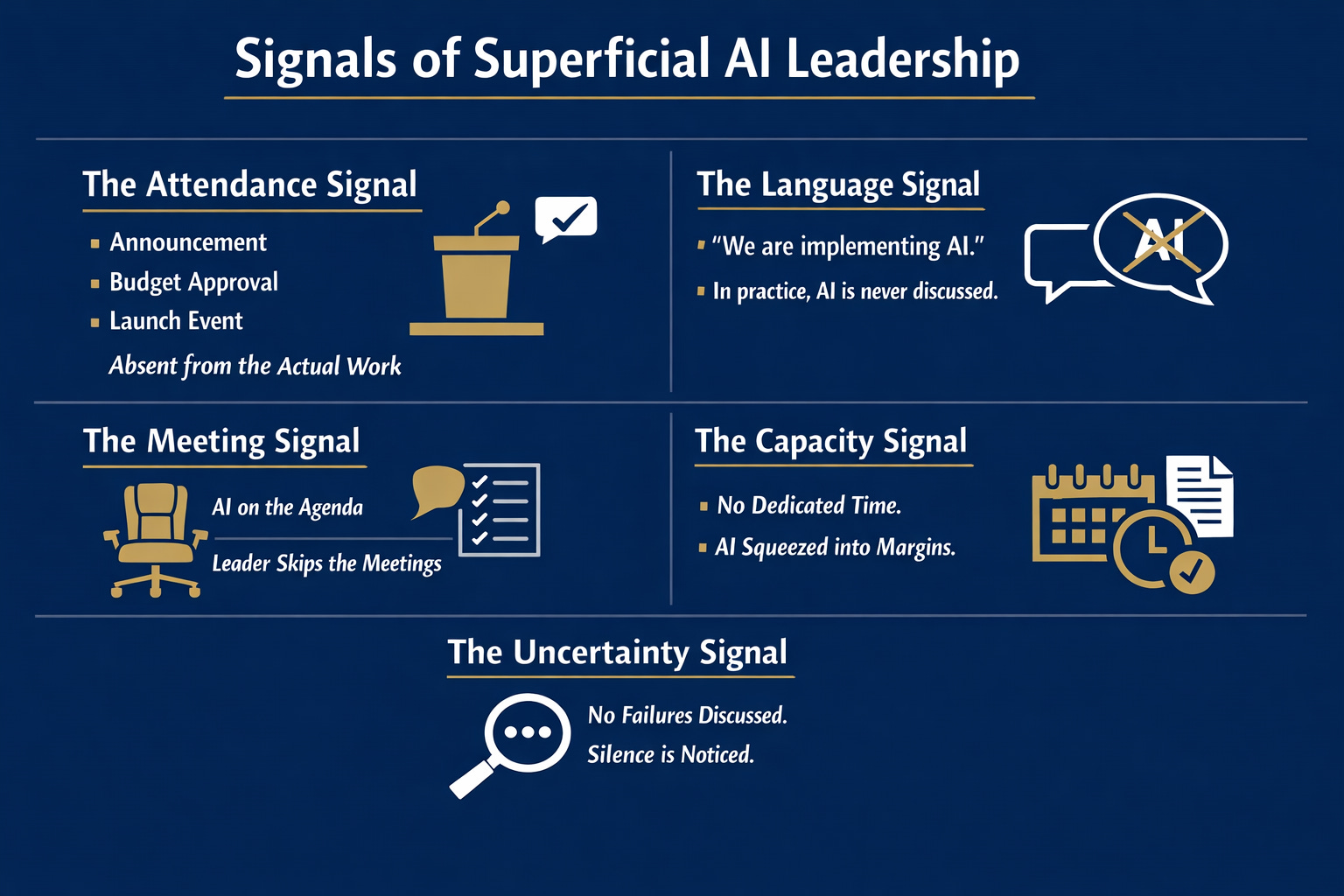
Teams are perceptive. They notice what you prioritise, what you ask about, what time you protect, and what you admit uncertainty about. From those observations, they form a view about whether AI adoption is actually important.
Most of these signals are sent without any awareness. That is what makes them worth examining.
The Attendance Signal. Present at the announcement, the budget approval, the launch event. Absent from the actual work. When the initiative was commissioned but the leader does not use the tools, the team reads endorsement without trust.
The Language Signal. In board meetings: “We are implementing AI.” In actual conversations with the team, AI never comes up. Teams hear both registers and draw the obvious conclusion: AI is something you announce, not something you do.
The Meeting Signal. AI is on the agenda for meetings the leader skips. When they attend, they do not ask about adoption. The team reads this simply: the leader does not want to know.
The Capacity Signal. Adoption is a stated priority, but the people assigned to it have no protected time. Their day jobs are unchanged. They are squeezing AI work into the margins. When the calendar remains packed with pre-AI tasks, behaviour says optional while words say essential. The contradiction is visible.
The Uncertainty Signal. No mention of a failure, a question, an experiment that did not work. Teams interpret silence as discomfort. If a leader were using AI tools, they would have something to say about it. The silence is the signal. And it is the hardest one to see in yourself, because the thing you are not doing feels like nothing. It is not nothing. It is a choice your team has already noticed.
Your team will not tell you
This is the uncomfortable part. Your team sees these signals, understands what they mean, and will not tell you about them.
The power dynamic makes honesty risky. You evaluate their performance. You adjust their scope, recommend their promotion, decide where they sit in the resourcing queue.
So they observe, they decide, and adoption stalls.
The strategy did not fail in execution. It failed because the team read the signals as the real priorities.
Five questions expose the gap
These are worth sitting with for a moment.
1. When did you last use an AI tool to do part of your actual work? Not a demo. Not a presentation. Your real job.
2. In your last team meeting, did you ask about someone’s AI experiment or result? If not, what got your curiosity instead?
3. Open your calendar from the last fortnight. Find one block where you used an AI tool to do the work, not just talk about it. If you cannot find one, your team cannot either.
4. Have you shared an AI failure of your own with your team? A tool that did not do what you expected? If not, what do you think your silence communicates?
5. Describe the most recent decision you made using an AI tool. Did anyone on your team see it happen?
Those five questions are a self-score on the five signals. Without an outside view, those scores stay comfortable estimates. The real data comes next: how your team would score you. Paid subscribers get the Leadership Signals Comparator, which pairs your self-assessment with a colleague score, plus every diagnostic from the series.
