

Hi there,
Start here if you are new to this series: Your AI Training Isn’t Working. Here’s Why.
The hardest part of a reset isn’t the planning. It’s the moment of saying out loud, in a room where it matters, that the current approach isn’t working.
That moment is uncomfortable for a reason. The training programme has a budget owner. The platform has a steering committee. The roadmap has been signed off. Naming that the direction is wrong puts earlier decisions on the table, including some you made. It feels personal in a way most business decisions do not.
Name the discomfort. It is what keeps most initiatives running long after they should have changed course.
The cost of not resetting is rarely visible on a dashboard. It shows up as another quarter of the same plateau, another round of training that does not stick, and the people closest to the work going quiet. You lose momentum, energy, and the trust of the people whose adoption was supposed to make this real.
The Cost of Continuing
The word “reset” carries weight. In technology it usually means something broke and had to be turned off. In leadership it can feel like an admission of error.
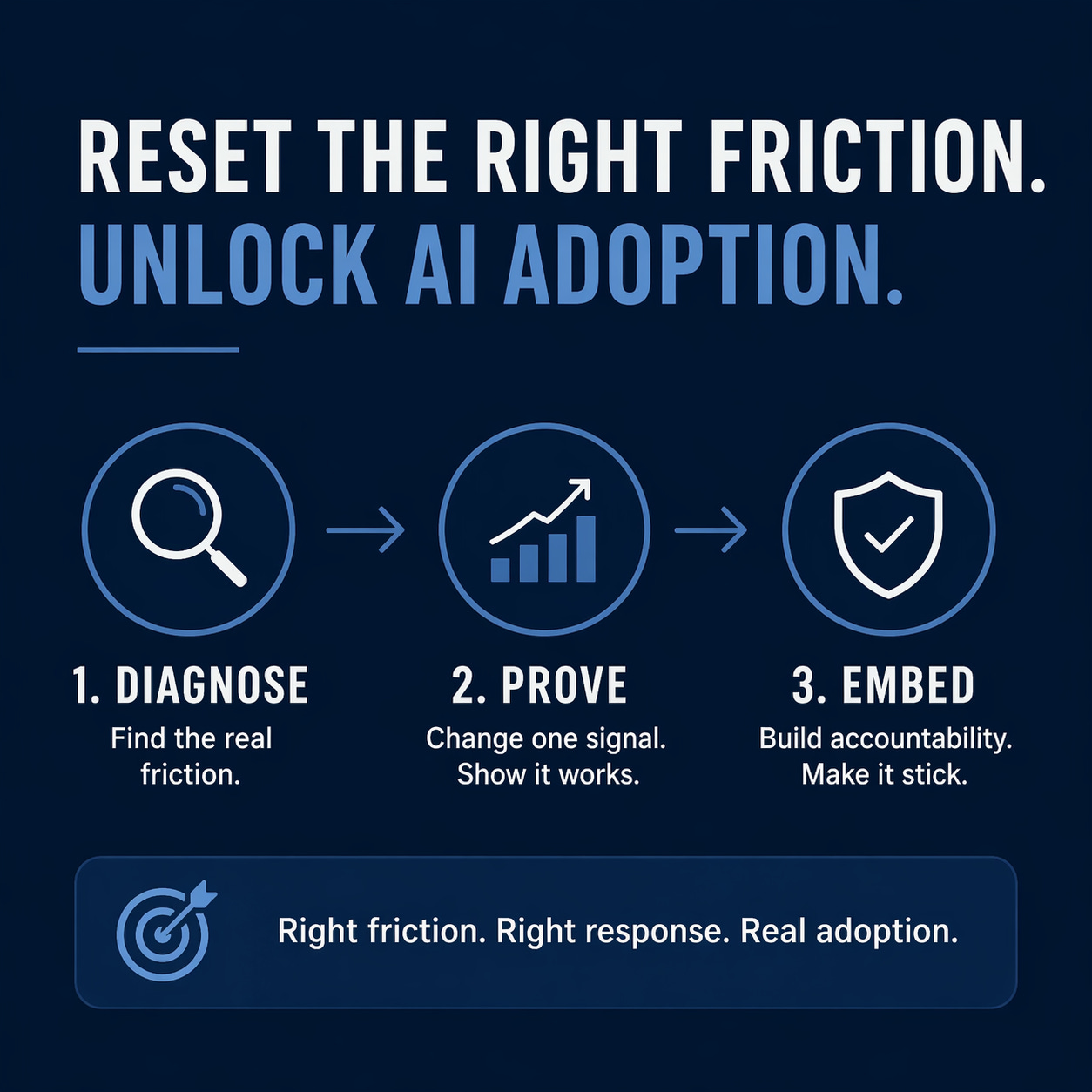
A reset is not an admission that the AI initiative failed. It is an admission that the response has been aimed at the wrong friction point.
A reset is the decision to stop investing in a friction point that is not in the way, and to start investing in the one that is.
Training does not fix cultural friction. Tools do not fix a credibility problem. Mandates do not fix a clarity gap. When the response and the friction are mismatched, the response can grow forever without moving anything. What it costs is the time, money and attention that could have gone somewhere else.
Resets that work tend to start in a similar way. A leader stops defending the current approach in the rooms where decisions are made. They name what is actually getting in the way. They redirect resources at it. The political cost of that moment is real, and it is finite. The political cost of avoiding it grows for as long as the wrong response keeps being funded.
What to Say in the Room
The reset needs a clean sentence, not a speech.
“We have been investing as if this is a training problem. The evidence suggests the friction is somewhere else. Before we spend another quarter expanding the current approach, we are going to diagnose what is actually blocking adoption.”
A sentence like that names the mismatch, avoids blaming the people who built the current plan, and creates permission to look at the problem again without pretending the previous work was worthless.
Do not over-explain. The more a leader defends the reset, the more it sounds like a failure. Say what has been learned. Say what will change. Move the conversation to evidence.
Phase One. Diagnosis. The First Four Weeks.
A reset starts with clarity. Not planning. Not solutions. Clarity about which of the five friction points is the one in the way.
The 5C framework names them: Clarity, Capability, Credibility, Control, Consequences. They ask whether people understand the change, can do the work, believe the priority, feel agency over it, and have a reason to move. The work of Phase One is finding which one matters most for this organisation, right now.
Week one. Map the signals.
There is more data already in the organisation than most leaders realise. Which teams turned the tools on. Which groups finished the training. Which departments responded to the strategy email and which did not. Where AI is being used informally, even in pockets the central programme has not noticed.
The work of week one is collecting, not interpreting. The signal is more specific than “people do not care.” The sales team is using the assistant. The operations team never logged in. One product squad has built a workflow nobody asked for. That texture is what matters.
Week two. Interview the friction.
Talk to people who adopted and people who did not. Not a focus group. A short, specific conversation. What would have made this easier. What got in the way. What was tried and abandoned.
Adopters describe what removed friction. Non-adopters describe what created it. Both are useful. The pattern to listen for is which of the five Cs surfaces in almost every conversation, even when nobody uses the word.
Week three. Analyse the pattern.
After eight to twelve conversations and a map of where adoption sits, a pattern emerges. It will not be “everyone struggles with X.” It will be more specific. The teams that adopted are high-agency teams in early-stage work. The teams that did not are in compliance-heavy functions where there is no cost to waiting and no reward for moving. The friction is Consequences, not Capability.
Or a different pattern. The people using AI tools have had a conversation with their manager about it. The people who have not, have not. The friction is Credibility, not tooling.
There is usually one primary friction point. Secondary ones exist. Moving the primary one tends to create space for the others to move with it.
Week four. Confirm and commit.
Take the diagnosis to the leadership team. Show the evidence. Do not propose the solution yet. The work of week four is agreement on the friction point itself. Once that agreement is on the table, the conversation about response becomes much easier, because the question has narrowed.
At the end of Phase One there is a named friction point, evidence behind it, and a decision from leadership that this is what the next phase will tackle. Everything after this depends on that foundation.
The full 90-Day Reset Sequence continues behind the paywall: weekly activities, deliverables, leadership prompts, and checkpoints for Phases Two and Three. Subscribe.