

Learning from a failed project is one of the best lessons you can experience.
If your AI rollout has failed or is failing, this is actually a good thing, not something to shy away from.
In this article, I’ll share a playbook for how to turn your change program around.
PS - if you missed this video, you should check it out:
In today’s newsletter:
Why mistakes build valuable knowledge
How teams deal with complex change
The playbook for successful AI change
1 - Why mistakes build valuable knowledge
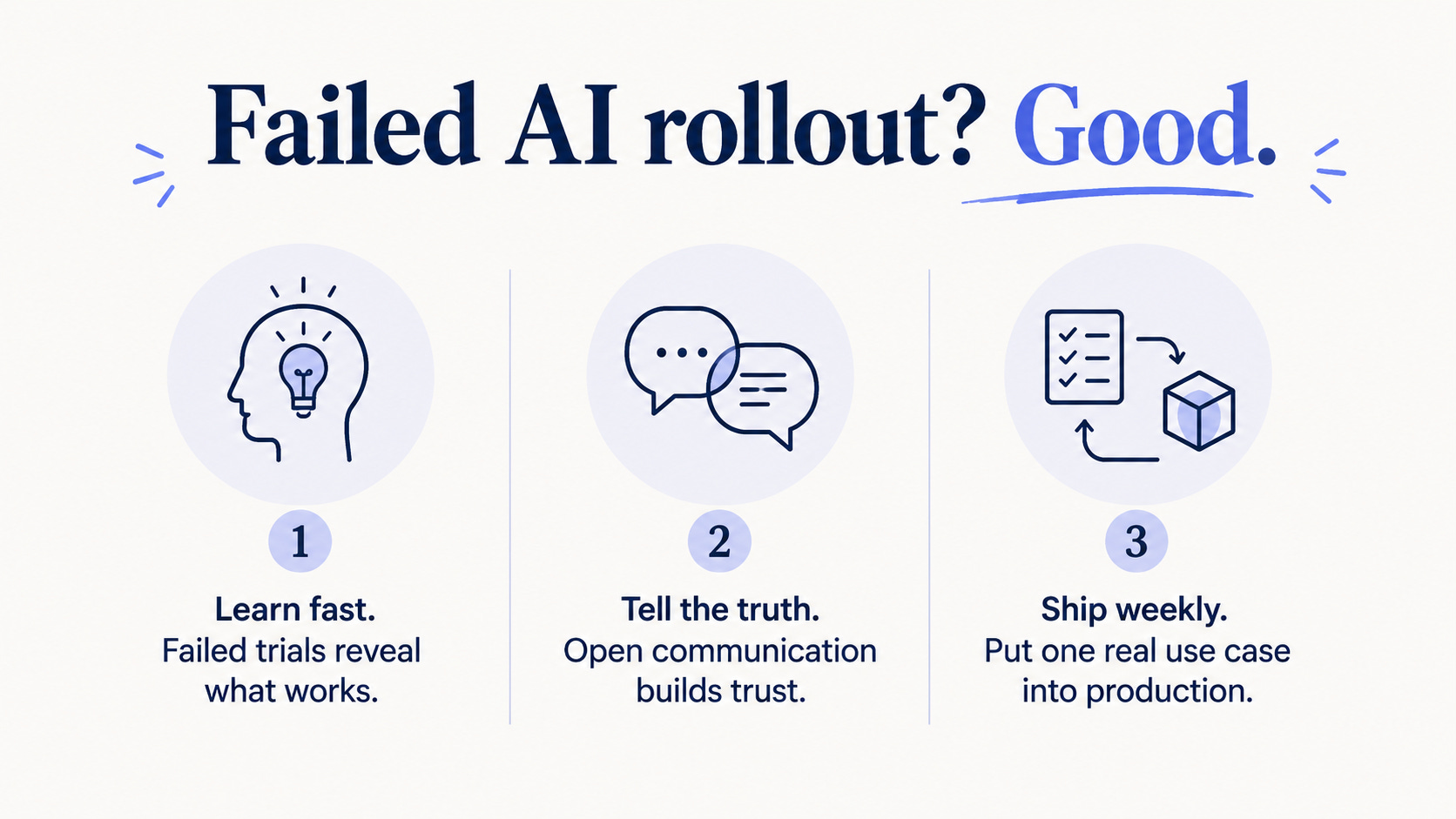
When you make mistakes with AI, you are building process knowledge. You learn what does and does not work with the tools and the environment you are working in.
Mistakes build valuable knowledge for business owners and leaders because they start to understand what needs to change. Everyone can drive a successful change program that leverages AI to do things better, faster, and cheaper.
The difference between tacit knowledge, living in our heads, and explicit knowledge, written down, matters. Here is where the intellectual property supporting a business’s ability to do things for its customers in a predictable, reliable, and high-quality way lives.
If you try to do something with AI and it works, you’ve learned something. If you try to do something with AI and it doesn’t work, you’ve learned something.
Because of the cultural impulse towards more risk aversion over the last few decades, an obsession with risk management has often killed off these important entrepreneurial trial-and-error processes.
This means that many companies have spent more time and effort worrying about AI governance and AI risk management than actually figuring out how to use the tools themselves.
They need an accurate fact base on which to reason about the risks involved and how to govern them. You could not dream up a more ironic example of putting the cart before the horse.
Some companies have spent months worrying about all of these concerns before they have even let their users have access to one license to conduct experiments.
This is why if you get to the point where you have had a failed AI initiative, you have accumulated valuable information. Some companies haven’t started the trial-and-error phase of AI adoption yet.
Every little step that you have taken in the direction of making your company more AI-first is a step where you have learned and improved. You have updated information.
For example, you will know who the natural AI leaders are in your business. You will know who is advancing change and who is blocking change.
When it comes time to think about organisational design, you will have a better sense of who leaned into this opportunity and who threw up roadblocks.
Action Point: If you still haven’t let your team do some trial-and-error and experiments, with the goal of making improvements to your operating model - get that sorted this week. There are ways to reduce the risk from light AI experimentation. You should be able to find one use case and get it into production every week.
2- How teams deal with complex change
What we know about change management from the literature, and what I know from my own direct experience in the space, is that a lot of teams struggle to deal with change. The more things that are changing at the same time, the harder it is for a team to process the change. There is such a thing as change fatigue or change exhaustion.
This is what happens when there are so many little things changing across how someone does their job every day that cumulatively, after many years of this, having something as threatening and emotional as AI potentially automating you out of a job is almost too much to process.
The rhetoric in the corporate world is about AI job layoffs. Reducing headcount is one way to realise benefits from AI investment. It is disingenuous for people to claim it is all about augmentation; some spend is intended to reduce payroll expenditure.
We need to be open and honest about all this AI change and what it means for teams in reality because they have lives to live and you owe it to them to be upfront. That openness, transparency, and communication is so much more important than I think a lot of corporate leaders realise.
When you work at big companies, you know that a lot of things are scripted and rehearsed. Communication is planned. Everything feels like it has this flavour of a Hollywood production.
People see through that. They know when you are talking absolute nonsense as a corporate leader or a business owner.
What you are doing when you choose that communication style is effectively saying that your team is incapable of handling the truth. It is a paternalistic and arrogant style which does not really work in the 21st century when constant streaming information is the default life experience.
When someone in your workplace picks up their smartphone, they are extremely exposed to the algorithms and everything they see and process. If they are coming into a work environment and your style is stuck in the 1990s, that means that everything you say is being filtered as if it is curated nonsense.
You don’t have trust. You have an environment where free and frank conversation can’t happen. There are other highlights of this which make adopting AI harder than it has to be. When there are things like restricted information flows, or instructions to “please cascade this information to your team”.
Everyone gets a different story about what the agenda is, why we’re doing it, how we’re going to do it, and when we need to be finished by. This is a common theme in failed projects- what you want isn’t what the team hears, and confusion makes it harder to get the change understood let alone adopted.
This means all these programs in the AI space face an uphill battle. You are going into an information ecosystem that is already anti-AI. How do you get cut through? That’s what I’ll talk about in the next section.
PS: I’m running a limited offer until midnight 1 July 2026. Upgrade your Getting AI To Work subscription to an annual paid one and you’ll save 30% today and 30% for the life of your subscription. Lock in your exclusive discount today.