

Hi there,
If you’re new here, I’m Brennan McDonald and I write about the people side of AI transformation. This newsletter grows through word of mouth and your recommendations. If you enjoy this, please share it with a friend today, it’s always appreciated. If you have any feedback, you can reply to this email. You can also find me over on YouTube.
- Brennan
In today’s newsletter:
Frontier time vs friction time
Why more thinking time matters
The Mistake Mining Playbook
Frontier time vs friction time
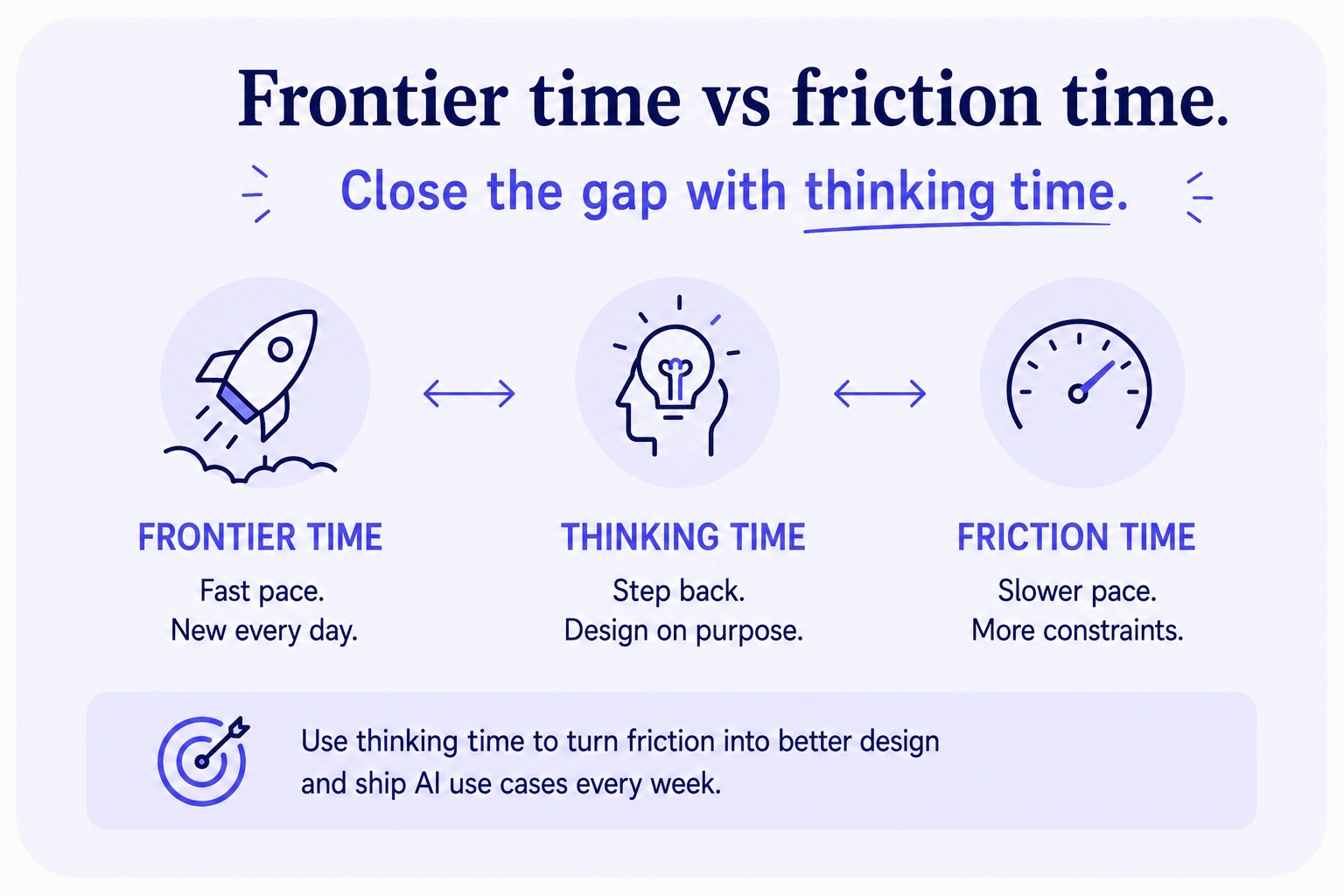
The firms that win with AI will not be the ones that move recklessly in frontier time or defensively in friction time. They will be the ones that use structured thinking time to close the gap safely.
There’s frontier time, the fast pace, something new every day, something better, something shinier, something loudly heralded or criticised on X in volume.
Then there’s friction time. Months to years behind where the frontier is operating, subject to a slower pace of adoption, the constraints of people, process and platforms, and considerations around governance and risk management that only those who have lived through the pain appreciate.
I’ve spent most of my career working in firms where friction time rules the day. There are always reasons not to do something. Not the time, not the people, not the budget, not the right compatibility with existing operating model capabilities.
At regulated entities in particular, we have things we care about where we want humans to be accountable for decisions. A lot of this friction time in isolation makes total sense. Do we want a vibe-coded core banking platform that doesn’t get proper testing? No way!
This tension between being an early adopter and not accidentally blowing up businesses that customers depend on is a very real part of what’s going through the minds of boards and executives when it comes to AI adoption.
At the moment, I pretty much live in frontier time. I literally am using AI every day for as much as I possibly can.
I spend a decent amount each month on making sure that I test out whatever I can, burning AI API usage so you don’t have to. When I work with people, I have as one of my goals to expand their mindset for what is possible with AI.
This is why Getting AI To Work has focused on the people side of AI change. Because of the pain I’ve experienced at the frontier, I know that for people living in friction time, there is so much pain relief that is possible if you clearly think about an AI-first operating model in your business.
There’s a reason why I say you need to start shipping AI use cases in production that your people can use to do things better, faster, and cheaper every week. You need to do whatever you can to reduce that gap between frontier time and friction time.
Does this mean you need to deploy a model to your people the day it comes out? No, but it does mean you should have someone in your business scanning that horizon. Scanning what is happening in real time, checking, testing, evaluating and recommending what the next pivot in your business’s AI adoption journey is going to be.
Why more thinking time matters
I’m not referring to thinking time when an AI model is generating its response to your query. I’m thinking about thinking time. You step away from your computer. You step away from the emails. You step away from the meetings. You actually reflect on what you want your AI-first operating model to look like.
The idea of path dependence where choices you make today have long-running impacts has never been more real to my mind. How you choose to respond to AI today as a challenge and opportunity could mean life or death for your business in a few years’ time.
These sorts of decisions can be expensive to reverse if you make the wrong one. If you picked the wrong mix of people, process and platforms and don’t have the right talent helping you achieve your transformation, you could be permanently locking in structural disadvantages.
There are clearly risks in AI that you need to manage. A lot of complexity in the AI space is about deciding where you want to automate and where you want to keep humans in the loop to avoid outages or mistakes leading to reputational damage or fines.
Thinking through all of these things and figuring out what you really want that operating model to look like, especially as an intelligent firm where you’re pushing more decisions and day-to-day activity down to AI agents, takes time and effort.
So some leaders can be forgiven if they’ve been moving slowly. The best ones have already figured out how critical this moment actually is. I’ve often referred to AI acting as a ray of sunlight. It reveals the cans you kicked down the road.
You’re now at the point in many boardrooms and executive meetings where AI pilots start revealing the consequences of some of these cans that have been kicked as far as you can get away with in the AI era.
You need to put in the thinking time to design your operating model in an AI-first way. Thinking time is about going from frontier time to friction time and not ending up in the wake of AI-first startups in your niche.
In the next section, I’ll share how you can run this playbook in your business today.