

Hi there,
This week’s article wraps up a 12-week focus on building out the 5C framework. There’s definitely a gap in much of the AI content I see and read around the human side of AI. That’s one of the reasons why I refocused this newsletter last year around the people side of AI transformation and change.
There’s more to an AI transformation than getting all the ChatGPT licenses and controls setup or making sure that everybody does their e-learning modules on time. The longer I’ve been in this space, the more I realised that there’s another area of content or education I need to share with my audience around what is possible with AI from an operating model perspective.
This will build on the change management focus here. It will give more usable diagnostics, playbooks and templates for you to unlock the next chapter of your AI transformation.
Start here if you are new to this series: Your AI Training Isn’t Working. Here’s Why.
The Pattern Behind the Quiet Failures
Somewhere in most organisations, an AI initiative is stalling. Not in a dramatic way. Not with a public failure. It is just slowing: launch energy gone, timeline slipped three times, the team meant to own it pulled onto other things, and nobody willing to say out loud that it might not work.
Most of the time, technology is not the part that breaks. The technical capability is increasingly available. Something simpler is missing: people have not agreed on why this matters, what should happen next, who gets to decide, or what success would look like.
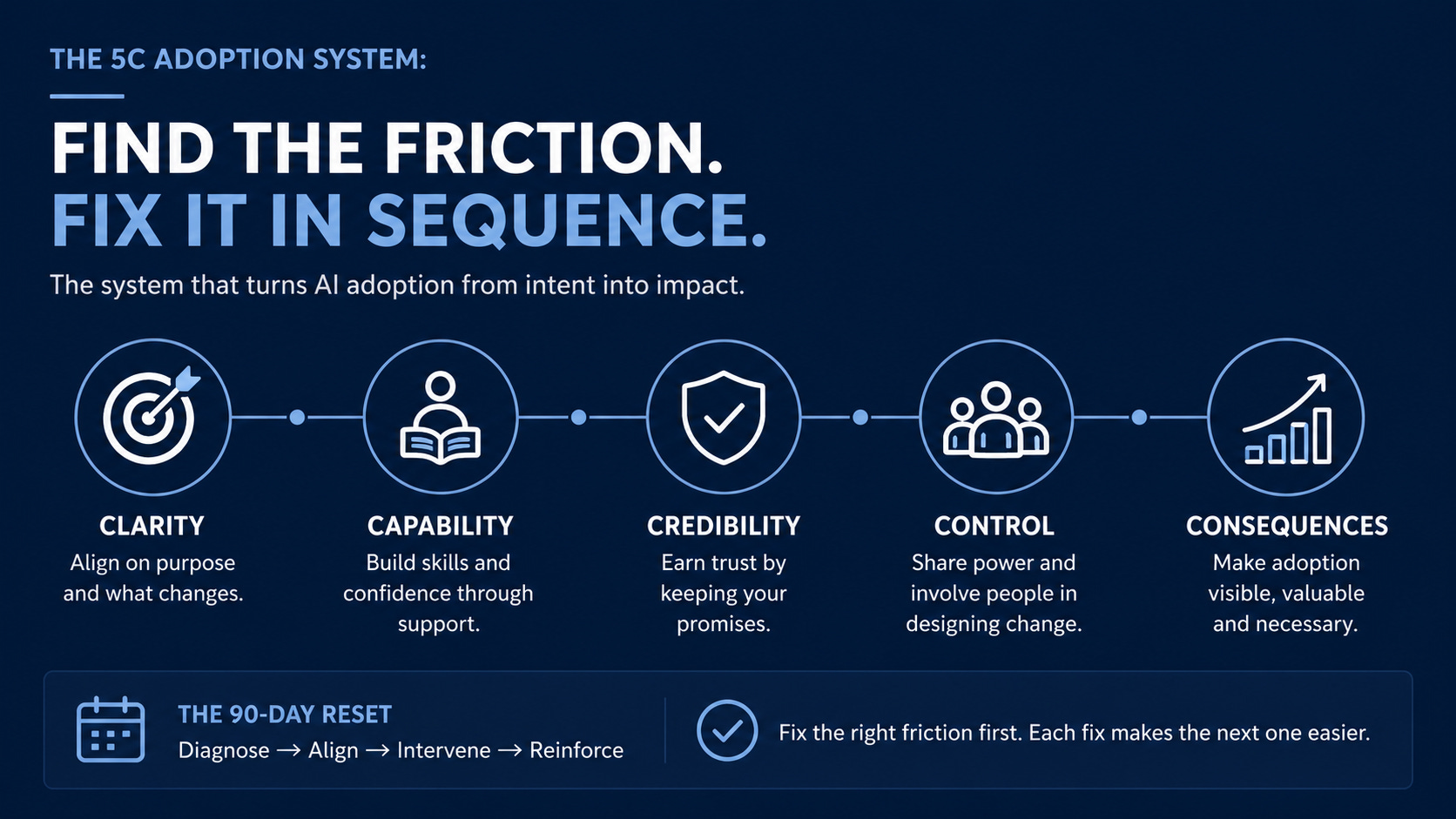
The ones that succeed run adoption as a system rather than a project. Over twelve weeks, this series has mapped that system through the 5C Adoption Friction Model: Clarity, Capability, Credibility, Control, Consequences. Ignore any one of them and it pulls the initiative off course in a way the dashboard will not show.
Find the friction. Remove it. Move to the next. This week, the system.
The Five Friction Points Condensed
Clarity is about whether everyone is working from the same idea of what this is for. Your CFO thinks it will save headcount. Your Chief People Officer thinks it will lift the team’s skills. Your product team thinks it will ship new features. Everybody below them gets a different story and picks whichever version keeps them safe. You end up with a pile of projects pulling in different directions.
Capability comes down to skills. You have an accountant who has spent ten years in Excel, and you cannot expect them to start building advanced AI workflows tomorrow. Not without training. Not without coaching. Not without some permission to slow down while they learn. People try anyway, fail, and blame the tools. Adoption stalls, confidence drops, and your would-be advocates stop volunteering.
Credibility runs on trust, which is fast to lose. Leaders talk transformation but never put a budget behind it, set deadlines nobody can meet, and quietly pull someone off the project the second things get hard. Each move tells the team this does not really matter, and eventually your people stop believing anything you say about change.
Control sits at the level of power. People worry about their jobs, role changes, how their data is used, whether anyone will ask how this should work. They will not say any of it out loud. So if nobody brings it up, the pushback shows up later, slow and quiet, and your most influential people end up blocking the work.
Consequences turn on the stakes for people. When adoption is optional, early adopters get no recognition, and there is no real cost to waiting or reward for moving, the rational thing is to do nothing. Six months on, you cannot point to any results, justify what you spent, or hold onto the budget for what comes next.
What All Five Have in Common
Even the skill problem is not only a skill problem. People are not refusing the tools. They are protecting who they are at work: their role, their authority, their standing. Underneath, you are looking at identity rather than just competence. Train through it and the training does not stick. Mandate around it and you make the resistance worse.
Most leaders need shared purpose before anything else holds, not because Clarity is always the deepest friction but because the other four cannot work without it.
The Diagnostic Sequence Principle
Most leaders go for the loudest friction, not the one that is actually in the way, and that is how things get worse.
Fix Capability before you have Clarity, and you train people for work that does not matter. Fix Credibility with more communication and you make the trust problem worse. Throw incentives at Control and people hear a threat. Fix Clarity without Consequences and everyone nods, then goes back to what they were doing. In the wrong order, the problem grows. In the right order, each fix makes the next one easier.
The Condensed Diagnostic
This is not enough to fix the initiative on its own, but it will show you where to start. For each friction point below, ask whether the description fits your situation.
Clarity
Can three different people in your organisation explain the purpose of your AI initiative in the same way?
Do your frontline teams know what they are expected to do differently, or are they waiting for clearer direction?
Has anyone said explicitly what problem this initiative solves, and for whom?
Two no answers means this is an active friction point.
Capability
Do the people expected to use AI tools have time and structured support to learn how to use them?
Has anyone measured the skill gap between what people have now and what they need?
Are people learning through trial and error, or through formal training and coaching?
Two no answers means this is an active friction point.
Credibility
Have leaders protected this initiative when it became inconvenient, or only supported it when it was easy?
When people express doubt, do leaders address it or dismiss it?
Have the people driving change made themselves available to listen rather than only to broadcast?
Two no answers means this is an active friction point.
Control
Have you explicitly named the decisions that will change, and who will make them?
Are the people whose authority is shifting involved in designing how that shift happens?
Are people saying “this is a good idea” in meetings but failing to change behaviour afterward?
Two no answers means this is an active friction point.
Consequences
Are there immediate consequences for adoption, and is it optional or required?
Are early adopters recognised and rewarded, or does the organisation treat adoption as invisible?
Is there a real cost to waiting, or can someone do nothing and face no consequence?
Two no answers means this is an active friction point.
Run the diagnostic and write your primary and secondary down. Whichever friction is blocking the others is your primary. The rest follow in sequence. Diagnosis matters. Get the order wrong and it does not work.
From Diagnosis to Action
By now you can see the pattern, and what happens next depends on whether it makes it into your next planning meeting or just sits in a document while another quarter passes.
Below is the Complete 5C Adoption System: the sequencing logic, the 90-day reset, and the conversation framework for the hardest friction.