

There is a question that sits at the centre of most stalled AI initiatives. It has been the same question since early in this series: “How is AI going for you?” Not the metrics version. Not the dashboard version. Not the version that gets asked in a survey and filed away. The actual question. The one asked in a one-on-one, with the door closed, and no one else in the room.
The initiative has been running for weeks. Or months. The adoption curves are visible. The dashboards are reviewed. The governance meetings happen. The budgets are approved, the timelines signed off.
And yet the question has not been asked.
Time is not the obstacle. Neither is knowing where to start. Something else is in the way. And that something is worth understanding, because the moment a leader stops measuring and starts asking is usually the moment things begin to shift.
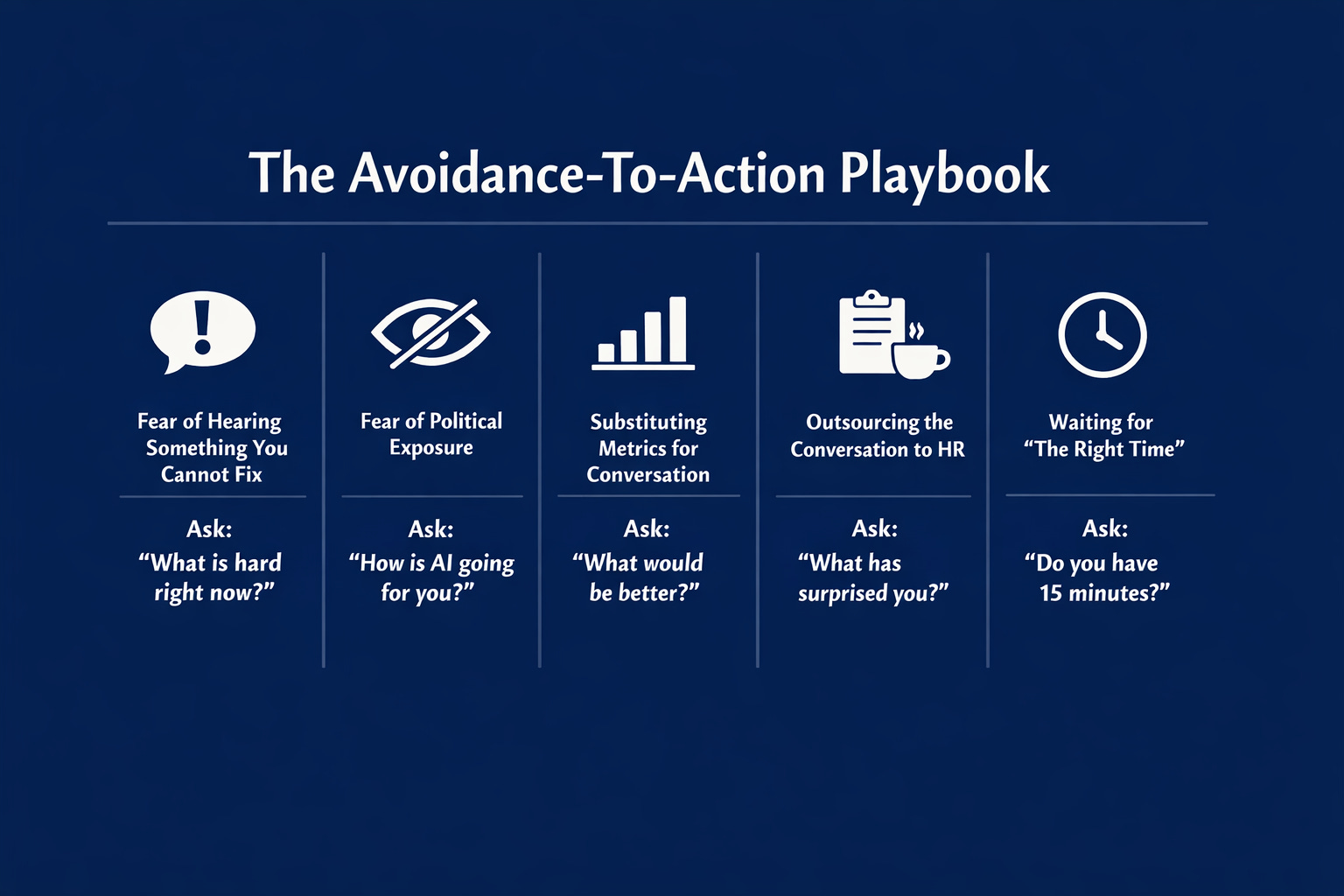
The Five Patterns of Avoidance
The question does not go unasked because leaders do not care. It goes unasked because something gets in the way. One of these five patterns.
Pattern 1: Fear of Hearing Something You Cannot Fix
This one is recognisable: the calendar is full of governance meetings. Process meetings. Steering committees. Vendor reviews. Project checkpoints.
The calendar is empty of conversations.
The governance meetings are about what needs to happen. The conversations would be about what is happening. There is a difference. And the instinct is to schedule more meetings about the thing instead of asking about the thing.
What this costs: the team sees a leader who measures but does not listen. Over time, they stop offering the real answer.
Pattern 2: Fear of Political Exposure
This one looks like delegating the question.
The conversation gets scheduled with the HR business partner. The transformation consultant does the listening. The programme director runs the one-on-ones about impact. You are not in the room when the team answers.
Understandable, as instincts go. Hearing feedback directly carries vulnerability. But the team notices who asked and who did not.
What this costs: the initiative loses executive credibility. The team assumes the leader does not want the real answer.
Pattern 3: Substituting Metrics for Conversation
The adoption dashboards get reviewed every week. User adoption rates. Feature utilisation. Time to competency. Session frequency. Charts. Trend lines. What never gets asked is: “What is this actually like?” The metrics tell you the what. The conversation would tell you the why. The longer the abstract version substitutes for the real one, the wider the gap grows between the numbers and the team’s experience. Eventually the dashboards stop measuring what matters.
Pattern 4: Outsourcing the Conversation to HR
This one hides inside a process that looks like listening: the survey.
You send a survey. Your teams complete it at their desk. Anonymously. Distance is the point. You get feedback without having to respond in real time. You get data without having to be present. You get information without having to sit in the silence that follows a hard answer.
The survey is the conversation you do not have to have.
What this costs: Response rates drop with every survey. Your teams learn that feedback is filed, not acted on. The words become sanitised. No one tells you what is hard because they have stopped believing it will change anything.
Pattern 5: Waiting for “The Right Time”
The conversation gets scheduled for after the next quarter closes. After the big announcement. After the next milestone. After the change programme matures. After things settle down.
The right time never arrives. There is always something else: another milestone, another phase, another reason the organisation is “too busy” for a real conversation. And every week the question waits, the window hardens into a norm. The team stops expecting the conversation. They stop preparing for it.
The Cost of One More Week
Each week of avoidance deepens the gap between what the data says and what the team is experiencing.
The adoption numbers may look fine on paper. The feature rollout may be on schedule. The budget approvals and stakeholder alignment may be in place.
What is missing is the truth underneath. The truth that lives in the conversations that are not happening. In the one-on-ones that keep getting postponed.
By next month, that gap will be wider. Teams will have made their own peace with the initiative, whether it works or not, and the distance between the dashboard and what is happening on the ground will have hardened into something no one questions any more.
Every friction point in the 5C model gets worse the longer this conversation does not happen. Clarity fades. Capability gaps go unaddressed. Credibility erodes. People quietly revert to old workflows, or use AI only for low-risk tasks while telling leadership adoption is going fine. Consequences remain absent: there is still no cost to waiting and no reward for moving.
It all starts because one conversation did not happen.
You recognised yourself in at least one of those patterns. The Avoidance-to-Action Playbook below gives you the micro-move for each one: the exact sentence, the exact meeting, and what to do with the silence that follows. Paid subscribers get the Playbook plus every diagnostic from the series.