

You can still put people at the heart of an AI transformation. But you actually have to think about them first.
For too long, corporate transformation has focused on the solution or the outcome, not the people doing the hard work to implement and operationalise the change. An operating model needs people, process, and platforms. Yet so many AI projects fail because people are an afterthought.
This is the context for the friction point nobody wants to name.
Here is how it typically plays out.
The initiative has everything going for it. People know what to do. They have the skills and time to learn. Leadership is visibly committed. There is even buy-in from the people whose status felt threatened.
And yet.
Adoption remains uneven. Some people have changed how they work; others have not. Six months in, you cannot tell the difference between those two groups in how they are evaluated, recognised, or promoted. They sit in the same meetings. They receive the same feedback. They progress at the same rate.
The people who adopted feel foolish for doing the work others skipped. The people who waited feel vindicated. The initiative is quietly dying, and everyone except leadership seems to know it.
The Silent Question
This is the final friction point in the 5C Adoption Friction Model. Where Clarity asks “What exactly am I supposed to do differently?”, Capability asks “Do I know how to do this?”, Credibility asks “Does leadership actually believe in this?”, and Control asks “Will this make me less valuable?”, Consequences asks something simpler:
“What happens if I just... don’t?”
Your team is asking this question constantly. They are not asking it aloud. They are answering it by watching what happens to colleagues who ignore the initiative.
If the answer is “nothing,” they act on that.
What Consequences Actually Is
Consequences is the absence of accountability.
Someone knows what to do. They can do it. They believe leadership is serious. They have no fear about their role. And they still do not adopt. Why would they? There is no downside to waiting.
This is not resistance. It is common sense.
If you have not created accountability, you have created permission to wait.
That sentence is uncomfortable. It should be. The absence of consequences is not neutral. It is a signal. Your team has read it accurately.
Is It Actually Consequences?
Before assuming Consequences is your primary blocker, check the alternatives.
The closest lookalike is Control. Both result in inaction. But they feel different.
Control (Fear): “I am afraid this will make me less valuable.” → Needs reassurance.
Consequences (Permission): “I do not have to do this.” → Needs accountability.
If someone is afraid, accountability will not help. Address the fear first. If someone is not afraid but still not acting, that is Consequences.
The other friction points are quicker to rule out. If people do not know what to do, that is Clarity. If they are trying and failing, that is Capability. If they are waiting to see whether leadership is serious, that is Credibility.
Consequences is the blocker when the path is clear, the skills exist, leadership is credible, fears are addressed, and people still do not act.
How This Typically Plays Out
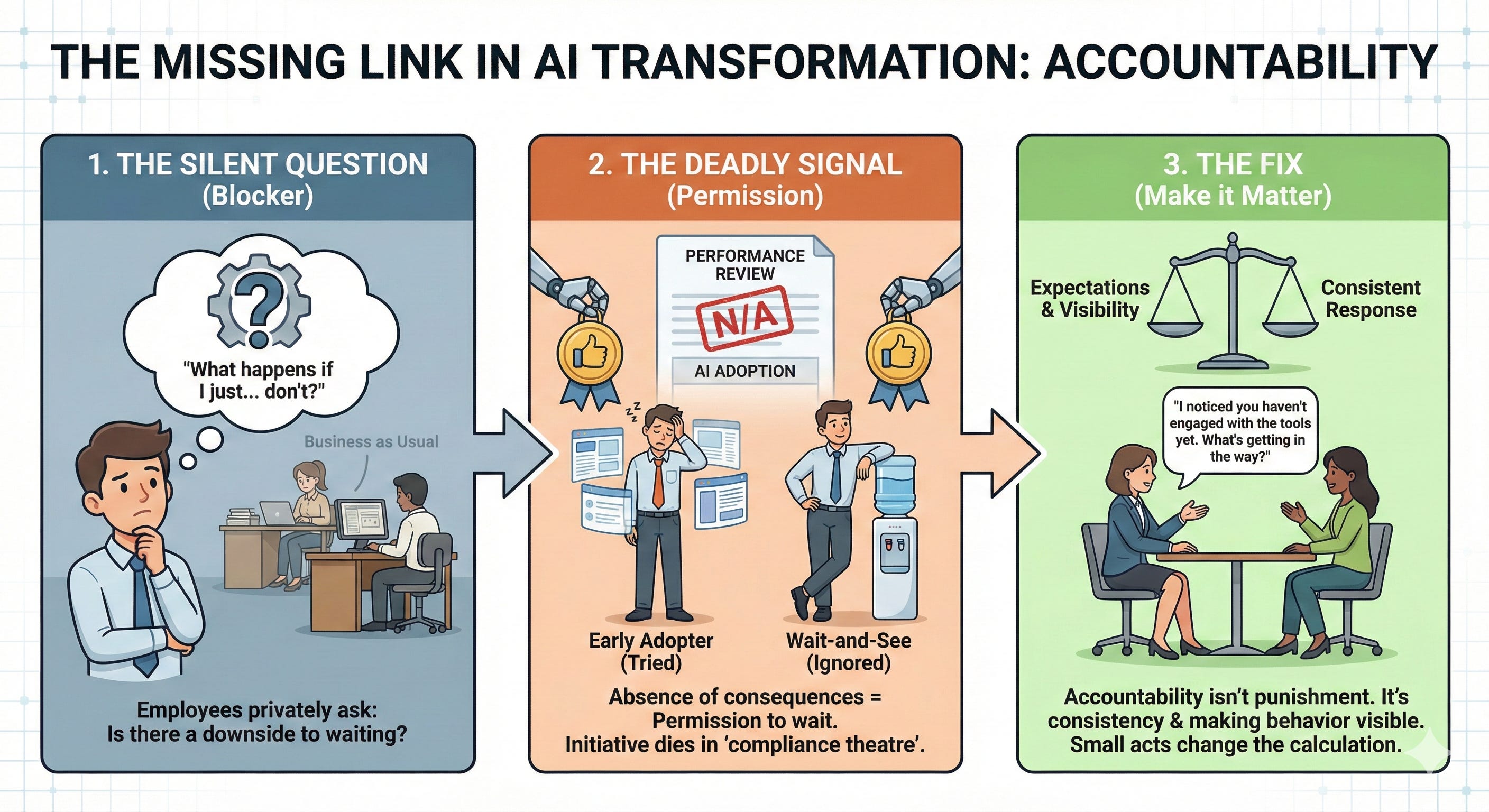
The initiative exists in announcements, town halls, and strategy decks. It does not exist in performance reviews, promotion criteria, or budget decisions.
“Use AI when appropriate” is the mandate. “When appropriate” means never, because no one has defined appropriate and no one is checking.
What follows is compliance theatre. People do exactly enough to avoid scrutiny. They log in occasionally so their name appears on the usage report. They attend the training and give positive feedback on the evaluation form. They nod in meetings when the initiative is mentioned. The dashboard shows “adoption.” Reality shows nothing has changed.
The early adopters start to notice. They invested time learning the tools. They changed their workflows. They took the risk of doing something new. And it made no difference to how they are perceived or rewarded. Meanwhile, the people who ignored the whole thing are doing fine.
Your best people are learning that initiative is not rewarded here. They are learning that the safe path is to wait and see. That lesson will outlast this project. It will shape how they respond to the next change you try to lead.
Why Leaders Miss This
One thing I learned in my corporate career was that a lot of people seem happy to manage to the minimum. If there are no consequences for not following through on AI transformation commitments, no one will take the initiative seriously.
But there is a harder truth beneath that.
A lot of people come to work on Monday with last week’s priorities already faded. Work is how they pay the bills. That is not cynicism. That is reality. Leaders cannot expect anyone to go the extra mile if the employee experience is not designed to recognise and reward it.
At the same time, poor performance has to be identified and fixed.
Leaders miss the Consequences gap for two reasons.
First, accountability feels punitive. Leaders want adoption to happen on its own, driven by enthusiasm rather than enforcement. Creating consequences feels heavy-handed, like you are forcing people to comply rather than inviting them to participate. Most leaders would rather inspire than enforce. So they avoid creating accountability structures, hoping that good communication and visible commitment will be enough.
Sometimes it is. Often it is not.
Second, the absence of consequences is invisible. You notice what is enforced. You do not notice what is not. From inside leadership, you see the town halls and the training budgets. You do not see what is missing: the connection between adoption and evaluation, between behaviour and reward. That gap is obvious to everyone watching from below. It is easy to miss from above.
The hardest part of accountability is that you cannot see your own inconsistency. You intend to follow through. Your team experiences whether you actually do. The gap between intention and follow-through is invisible to you by definition.
The Fix
The fix is not punishment. The fix is making adoption matter.
Three elements are needed: clear expectations, visibility, and response. Most accountability structures fail because they get the balance wrong. Too much visibility becomes surveillance. Too little response becomes permission. Vague expectations make accountability unfair.
Getting this balance right is harder than it sounds. The playbook walks through each element and shows you how to design accountability that feels fair, not coercive.
One Thing You Can Do This Week
Think about the last person on your team who ignored the AI initiative entirely. Not someone who tried and struggled. Someone who simply did not engage.
What happened to them?
If the answer is “nothing,” you have a Consequences problem.
Here is the smallest unit of accountability: in your next one-on-one, ask one question.
“I noticed you have not engaged with AI tools yet. What is getting in the way?”
That is not punishment. That is inquiry. It takes thirty seconds. And it signals something your team has not heard yet: someone is paying attention.
What Success Looks Like
When accountability is in place, the calculation changes. Waiting stops being the safe path. People start asking “How do I demonstrate progress?” instead of assuming they can wait indefinitely.
Early adopters feel recognised. Late adopters feel the gentle pressure of visibility. The initiative stops being optional.
This does not require punishment. It requires consistency. Every performance conversation that mentions adoption, every recognition of someone who experimented, every inquiry into non-adoption builds the pattern.
The Playbook
You need great people and their expertise to work the edge case problems and cover the gaps that AI agents are years away from solving. That is why the sequence matters. The first four Cs are about designing for people. Consequences is what makes that design real.
The Consequences Playbook gives you the structure to make adoption matter without making it punitive. It includes the self-assessment that surfaces the gap between what you intend and what your team observes, the framework for balancing expectations, visibility, and response, and the conversation script most leaders avoid.
This is the fifth and final playbook in the series.
Upgrade your subscription for the full playbooks!