

There is a question circulating in your organisation right now. It is not being asked in town halls, feedback surveys, or team meetings. It is the question people ask themselves, quietly, after the presentation ends and the slides get filed away.
“What exactly am I supposed to do differently?”
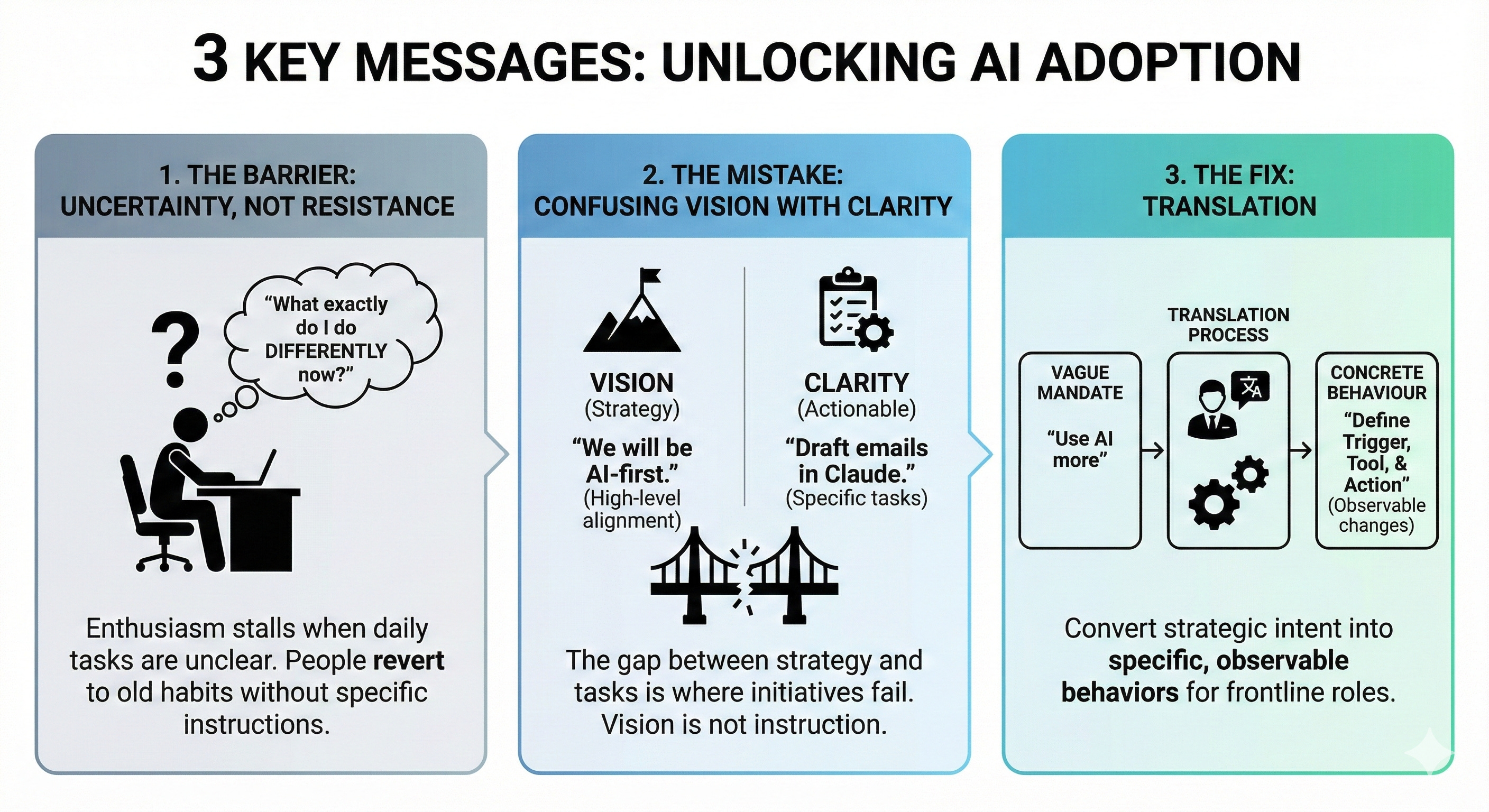
This is the silent question. The one that sits between enthusiasm and action. Your people may genuinely want to adopt AI. They may have attended the training, nodded along to the strategy presentation, and agreed that this matters. But when they return to their desk, the uncertainty sets in. What does “using AI” actually look like for their specific role, their tasks, their Tuesday morning?
Last week I introduced the 5C Adoption Friction Model. Clarity is the first friction point, and one of the most common. If your adoption initiative has stalled, this is where to start looking.
What Clarity Actually Means
Clarity is not vision. Let me be direct about that distinction because it is where many AI projects start to sink.
Vision sounds like this: “We will be an AI-first organisation.” Or: “AI is central to our strategy for the next three years.” These statements have their place. They signal intent, secure budget, and align senior stakeholders. But they are not instructions.
Clarity sounds like this: “Use Claude to draft every client proposal before the Monday review.” or “Use ChatGPT to check each deliverable before it’s sent out”. That is something a person can actually do. That is something a manager can observe and support.
The gap between strategy and tasks is where initiatives die. Organisations do the hard work of building executive alignment, securing investment, and communicating the strategic importance of AI. They do everything right at the top of the organisation. But there is a translation layer missing. The strategy never becomes behaviour.
Here is a diagnostic question worth returning to: Can three people on your team describe, in concrete terms, what they are supposed to do differently tomorrow? Not the vision. The actual tasks. If you ask three people and get three different answers, you have a Clarity problem. If you ask three people and get vague gestures toward “using AI more,” you have a Clarity problem. If they can each name a specific task, a specific tool, and a tangible workflow change, then Clarity is probably not your friction point.
How to Spot a Clarity Problem
You’ll recognise this one: vague mandates, unclear ownership. Leaders say things like “we need to use AI more” or “find ways to integrate AI into your work.” People nod in meetings and do nothing afterward. Nobody’s sure who’s responsible for what, or how success gets measured.
That is the most common pattern, but there are others.
High training attendance with flat adoption is a strong signal. The sessions were well received. The feedback forms came back positive. People said they found it useful, interesting, even exciting. And then nothing changed. The tools sit unused. The workflows remain untouched. Positive sentiment without behaviour change almost always points to Clarity.
Pockets of success that do not spread tell a similar story. There are often individuals or small teams who have figured it out for themselves. They are getting genuine value from the tools. But their success is not replicating across the organisation. This happens when adoption depends on individual initiative rather than clear guidance. The people who thrive in ambiguity will find their way. Everyone else waits.
Another signal: “What should I actually use it for?” asked repeatedly. If this question keeps surfacing in different forms, in different meetings, from different people, it is not a training problem. It is a Clarity problem. People are telling you they do not know what to do.
Watch for managers who cannot answer when team members ask for specifics. If your middle managers are uncertain about what adoption should look like in their teams, your frontline staff have no chance. Clarity breaks down at this layer more often than anywhere else.
Why Leaders Miss It
Leaders assume the vision is obvious. It never is. People need specifics: which tasks, which tools, which workflows, by when.
This is worth sitting with for a moment. If you are a senior leader driving an AI initiative, you have been thinking about this for months. You have read the reports, attended the conferences, spoken with vendors, debated the strategy with your peers. The logic feels self-evident to you now. Of course people should use AI for drafting. Of course it makes sense for analysis. Of course this will change how we work.
But your team has not had that journey. What feels obvious to you is invisible to them. They were not in the strategy sessions. They did not see the vendor demos. They received a presentation and an invitation to training. The gap between your understanding and theirs is larger than you think.
There is a cognitive bias at play here: the curse of knowledge. The more deeply you understand something, the harder it becomes to remember what it was like not to understand it. You cannot easily un-know what you know. This makes it genuinely difficult for senior leaders to see where the confusion lies.
Vague mandates can also feel empowering. “Find ways to integrate AI into your work” sounds like autonomy, like trust, like respecting people’s expertise in their own roles. But vague mandates produce vague results. What feels like empowerment often functions as abandonment.
What Staying Stuck Costs
The cost of a Clarity problem is not abstract. It is sitting in your budget right now.
Here is how this typically plays out. A firm with 200 employees is paying $50 per month per AI licence. That is $120,000 per year on tools. If those tools sit unused because people do not know what to do with them, that spend is producing nothing. And that figure does not include the training costs, the initiative team’s time, or the consultant fees that often accompany these rollouts.
Every month without Clarity is another month of that spend compounding against you. The licences renew. The opportunity cost grows. Your competitors, or at least the ones who have figured this out, are building capability while you are still waiting for adoption to happen.
Meanwhile, the team or individual who did figure it out is compounding their advantage. They are getting faster. They are producing better work. They are learning what works and what does not. That gap widens every week.
The Fix: Translation
The fix is translation. “Use AI more” has to become “Draft client emails in Claude before sending” or “Run your first analysis through the tool before building the spreadsheet manually.”
Translation is the work of converting strategic intent into concrete, observable behaviour. It is not glamorous work, but it is the work that produces adoption.
The translation process follows a consistent pattern. Start with the vague mandate. Identify one workflow where AI could add value. Name the specific tool to be used. Define how often it should happen. Describe what “done” looks like.
Here is an example. Suppose the vague mandate is: “Use AI to improve client communications.” This is a reasonable strategic goal, but it is not an instruction.
Translated, it becomes: “Before sending any client email over 100 words, draft it in Claude first. Copy your draft into the tool, ask it to check for clarity and tone, review the suggestions, then send.”
Notice what that translation provides. A clear trigger: emails over 100 words. A named tool: Claude. A granular action: copy, prompt, review, send. A defined frequency: every time. That is something a person can actually do. That is something a manager can observe, support, and measure.
The translation does not need to cover every possible use case. It needs to cover one. Start there. Build the habit. Expand later.
What Comes Next
Clarity is one of five friction points. If you fix this and adoption still does not shift, the friction is elsewhere. Control and Consequences are the next places to look. Return to the diagnostic from the first post and work through each friction point systematically.
The question to hold onto is this: Can your team describe, in specific terms, what they’re supposed to do differently tomorrow? Not the vision. The actual tasks.
If the answer is no, or if the answer varies wildly depending on who you ask, start here. Translate the strategy into behaviour. Make the abstract concrete. Give people something they can actually do.
Paid subscribers receive the Clarity Playbook, a step-by-step guide to running this translation process in 48 hours. It includes diagnostic questions, translation templates, and common failure modes to watch for.
For hands-on support with your AI adoption initiative, book the AI Change Leadership Intensive.
One last thing
The best insights travel through trusted networks. If this issue sparked a useful thought, you probably know someone else who would benefit from it too.
No pressure, but if a colleague or friend comes to mind - someone grappling with the realities of AI transformation - feel free to pass this along. Good thinking is better when it is shared!
