

I know you want to get more out of AI in your business, and in this newsletter, I’m going to explain why AI can do more, you just have to let go.
We learn from mistakes, and we accelerate progress through making more smart, risk-adjusted moves. My claim today: AI works fine, you’re just not pushing it far enough.
Most AI advice is too shallow. It focuses on tools, prompts, and isolated use cases. This piece is longer because the real issue is deeper: AI only works when leaders change how work happens.
We already know that AI can help you rewrite an email, build a spreadsheet, or automate the production of social media posts. But leaders need to stop using it like a productivity toy and start using it as an operating model redesign lever.
The gap between companies that are getting returns on AI and those that are writing off failed AI projects isn’t about the model capability. It’s about ambition, integration into the business’s daily operations, and leadership.
There’s a lot of talk at the moment about companies struggling to find the return on spend for their AI subscriptions and AI API usage. I think that’s because the focus has not been enough on the people and the change management side. Too much attention has been given to treating the rollout of AI like a tool provision exercise, not an operating model redesign exercise.
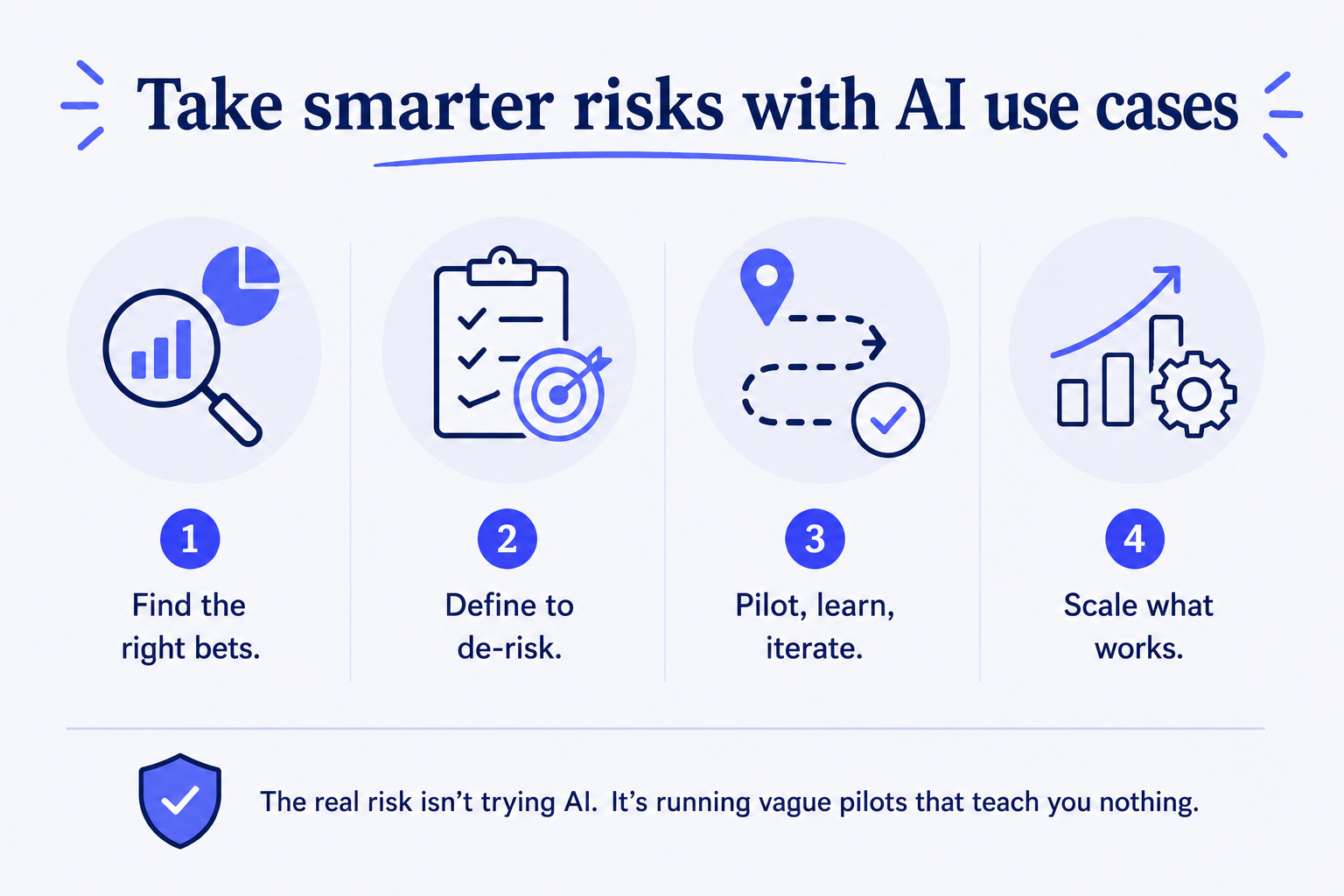
Take smarter risks with AI use cases
Time is the dominant factor in gambling. Risk and time are opposite sides of the same coin, for if there were no tomorrow there would be no risk. Time transforms risk, and the nature of risk is shaped by the time horizon: the future is the playing field. - Peter Bernstein, Against the Gods
AI adoption shouldn’t be reckless. It can’t be too timid either. A 2024 Gartner study predicted that by the end of 2025 at least 30% of AI projects would be abandoned after the proof of concept because of poor data quality, weak risk controls, increasing costs, or unclear business value. They weren’t wrong.
At the same time, the HBS and BCG Jagged Frontier study found that consultants completed 12.2% more tasks and worked 25.1% faster on tasks inside the AI capability frontier. Consultants who over-relied on AI for tasks beyond what it was capable of struggled.
I know from my own AI testing and work over the last 18 months, the lesson is very clear: AI works, and it works well. However, this is only when you’re working on the right use case with the right model, the right harness, and the right context.
The way you take smart risks with AI use cases is to make sure that every use case has a clear owner, a measurable outcome you are targeting, guardrails around what cannot be done, and a due date.
You want to be asking, “Where are we wasting time?” or “Where are we doing things that are repetitive, context-dense, too slow, or inconsistent where we’re using manual processes when we could be automating with AI?”
When it comes to getting AI to work, I hope that you’ve learned that the real risk isn’t trying out AI and giving your people licences to use ChatGPT or Claude. The risk is running vague pilots and proofs of concept that don’t teach the business anything new, and don’t give you lessons to be learned and folded into a wider portfolio of AI bets.
Some of these bets will fail. Some of these will deliver core workflow enhancements that save a lot of time and money. More ambitious ones will start to shift the economics of your business. We’re getting AI agents to do tasks at scale and in volume. Where they are better, faster, and cheaper at doing them, it shifts the economics of your operating model and starts to push those return on spend numbers in the right direction.
Waste less time on manual processes
Manual work hides in plain sight: customer support that could be self-serviced, meeting notes that never become actions, spreadsheets moved between systems, documentation reviewed manually, and emails that exist only to coordinate work that a workflow could have handled.
AI gives leaders permission to start attacking a lot of the repetitive and low-value work that exists in every team in their business. The first generation of AI value delivery is shrinking or compressing waste, cutting the time between getting a lead and sending out a response.
Holding a meeting and taking action, getting a question and issuing the answer (all of this stuff isn’t glamorous). But inside every operating model, there are operating processes that are currently far too manual. System one doesn’t talk to system two. Even though an API key exists, no one in the business knew what it was. So, people will be downloading information into a spreadsheet, reformatting it, and then uploading it into another system.
When I think about wasting less time on manual processes, using AI in your business is partly about discovering all of this waste and inefficiency. Instead of having to wait months to do something, you can start removing waste in an afternoon.
We can redesign and reimagine how the whole end-to-end process can work. We do not need to make broken processes faster. We can start drilling into why the processes exist at all. In the example I mentioned above, just by automating data transfer between systems, some businesses could free up entire teams that are currently just doing back-and-forth data reconciliation.
Take advantage of AI leverage to create value
I think a lot of the AI conversation is focused too much on reduction: saving time, saving money, and letting you reduce headcount. A bigger opportunity is creating new value, improving product quality, improving response times, closing customer requests faster, and adding product features. All of these new value creation ideas are easier than they’ve ever been.
Saving time isn’t the finish line for an AI project, it’s an opportunity for teams that have that freedom to start running more experiments. An example in my own business has been doing A/B testing and quantitative analysis of what’s working and what’s not.
Leaders using AI well shouldn’t just have much nicer-looking dashboards, spreadsheets, and well-formatted emails with perfect grammar.
The real value comes from shortening that decision cycle, where problems get surfaced faster with richer information to help support better decisions.
For example, self-service data and analytics was a challenge for many years. Yet the lack of technical skill on the part of a lot of people meant that they were still hamstrung by what a data and analytics team could produce for them.
You can now use natural language to query and get answers to questions that previously might have taken someone in the data and analytics team a couple of days to make sure everything was right.
You obviously need a lot of testing, quality control, and data governance around it, but you can just start and learn. You can find out what works and what doesn’t, and where the data quality is good enough and where it isn’t.
When it comes to the value you can get from using AI tools properly, the last place you want to be is in more meetings and emails going back and forth. You want more outputs and outcomes. You want to be moving the dial, not creating a whole new architecture of governance and bureaucracy around AI transformation.
Become more ambitious with operating models
Most businesses are still trying to roll out AI inside their operating model and their org chart exactly as it stands today. There’s a leadership-employee perception gap where leaders think that managers are creating space for AI experimentation, trial, and error, but fewer employees think that’s actually what’s happening.
The barriers around change management and organisational culture dictate how people try things, and what the organisational response is whether things work or don’t. If there’s a blame culture that does not let people make mistakes, you just are not going to get the results, compared to an organisation with a learn-from-mistakes culture that lets people learn and move on.
The real operating model redesign opportunity isn’t about giving everyone ChatGPT access. It’s thinking about how work flows across the business.
In this newsletter and in my videos, I’ve spoken a lot about questions which aren’t really being asked yet. Why do functions exist for some value streams? Why do teams exist? If you think about the task-by-task flow for some value streams, if you have processes that move back and forth across teams with no clear gateways and quality control checkpoints, you can probably redesign these workflows with the help of AI agents. Instead of having three or four teams touching a work product, you can have one flow handled by one team. You fold the contributions from each team into the workflow itself, complete with the evals, controls, and guardrails that you desire.
Then, the specialist experts act as the quality assurance and performance improvement people, owning and remaining accountable for the delivery of that new workflow. We’ve got an opportunity to redesign everything.
If you think about realising the benefits from all of this spend, it’s obvious to see why some companies will never realise $1 of net benefit from AI spend. They have not changed how they work at all. The entire point is a complete rethink of how we do everything.
The future operating model isn’t humans versus AI. It’s a collaboration of people, AI, processes, unique IP, and knowledge, sitting inside whatever guardrails the board or company owners want to put around it.
PS: I’m running a limited offer until midnight 1 July 2026. Upgrade your Getting AI To Work subscription to an annual paid one and you’ll lock in a 30% discount today and keep that 30% for the life of your subscription. Lock in your exclusive discount now to get access to all paid articles.
