

Hi there,
You’re thinking about AI costs the wrong way.
A lot of commentary is written about AI costs and how much firms are spending on tokens.
I’ve even indulged in some of this myself.
In today’s post I’m going to share why large spending on AI can make complete commercial sense.
Can you spend too much on AI?
Cost per task matters when you are building an AI-first operating model.
If a solo operator spends $100,000 a year on AI, is that too low, about right, or too much?
If a 1,000-person firm spends $100 million a year on AI, is that too low, about right, or too much?
Whether AI spend makes sense depends on its wider context.
How big is the business?
Who is running this initiative?
Are the right guardrails and governance in place?
What are they really using AI for?
How big is the opportunity that they’re targeting?
How long will this spend level last - is it build or run?
Is this removing things from the operating model permanently?
Is this a major cost avoidance or reduction in regulatory risk?
The right unit of analysis isn’t a token
I think the “token maxing” trend was downstream of a wider anti-AI pushback trend in the workplace where many workers, even when given access to the best technology of the era, don’t want to put any effort into using it and learning something new.
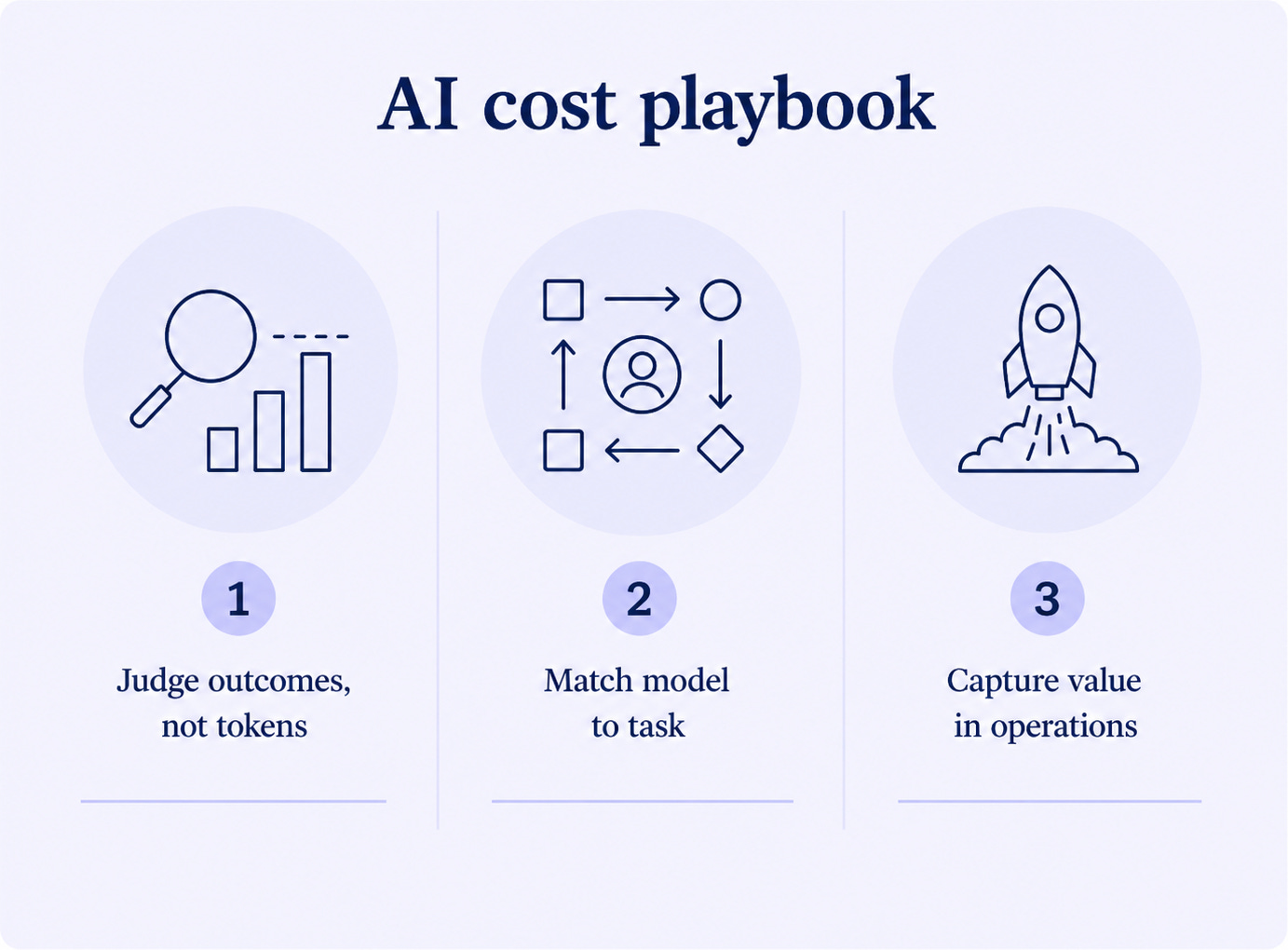
Instead of thinking about tokens consumed, think about the business benefits. Time savings, error rates and rework are the easiest to plan, measure and realise.
For each use case, articulate the benefits and how they will be realised. An AI project is just another project.
One common failure mode I’ve seen is finance-minded folks thinking they can control cost by restricting models. This can be catastrophic!
For a detailed adversarial review of a plan, Fable 5 can justify a higher per-task cost than Gemini 3.6 Flash.
If you’re not operating at that level of detail, you shouldn’t be imposing cost controls and usage guardrails at that level.
This is where many firms go wrong: severe guardrails and cost controls imposed up front tie teams’ hands before they can experiment towards better cost efficiency.
Big returns are plausible for some firms
You don’t need major percentage improvements if an initiative is wide enough.
Not backfilling roles through natural attrition, or redeploying people between functions, represents a real benefit to a business.
Deferring hiring for six months in roles previously filled at scale can generate savings beyond generous AI budgets.
Removing a vendor category, SaaS subscription or enterprise product feature at renewal can produce the same result.
At larger firms, a 3% reduction on a $100 million spend can justify significant investment, depending on hurdle rate and expected payback.
Enormous numbers can be plausible when you are improving a $10 billion payroll or $3 billion vendor spend.
There is a jagged frontier of adoption
The jagged frontier means some AI use cases are proven enough that piloting them is a waste of time: agentic engineering, long document review, or infographics.
Everyone competent knows that you can use these use cases and execute them at a decent level of quality. This is limited only by your own skill level and the models and harnesses you’re using.
For more complex use cases, a human in the loop with the skill and taste to see what needs rework is still required.
In many industries, human-in-the-loop quality review is non-negotiable, especially when work interfaces with regulatory requirements. In legal practice, rules vary by jurisdiction, but lawyers remain responsible for verifying AI-assisted submissions and following any court-specific directions on disclosure or use.
AI transformation is trial and error, like every new technology. Clear scope matters, but AI is surfacing blockers elsewhere in the business faster.
If systems cannot talk via API, or data rules are unresolved, agentic coding tools quickly expose the legacy technology and poor decisions underneath.
The call many leaders make is that this is now “too hard” and “AI didn’t work for us” - when all it did was force a look in the mirror.