

Hi there,
Over the last couple of days, I’ve been researching something you probably think about when you hear corporate leaders talk about what they’re doing with AI, but may not have examined in detail: what’s going on under the hood.
When a CEO claims on an earnings call that 10,000 people are being laid off because of investments in AI, that’s just the surface-level proclamation. When you look under the hood, what is often happening is that the 10,000 number is made up of people who were going to leave anyway because of retirement or churn, the movement of headcount from a big corporate to an outsourced vendor, or even an FTE-equivalent number made up of hours saved from processes that started getting automated years before the ChatGPT moment.
Every case is going to turn on its own facts, but over the last few years, before AI model capability could even justify some of the claims being made, it was clear that trying to label every cost-cutting measure as AI-linked would be rewarded by capital markets.
My take that I’m going to unpack in this article is that there are three things going on here:
AI capability is very real and already delivering results
The evidence is weaker for AI already causing large-scale job losses
There is an AI capability-to-deployment gap, not fully explained by culture
That is to say that deploying AI yourself and deploying AI in an enterprise environment are two very different things. There are all manner of considerations that a business needs to worry about: provisioning and permissions, how AI tools integrate and connect to other systems, and what sort of evaluation and testing processes are in place.
When you read an article that claims AI does work or doesn’t work, this is so simplistic that it’s essentially worthless if you’re a business owner or leader thinking about how you actually get AI working in your business.
Every operating model has so many moving parts. That is why, when I talk about an AI-first operating model, I talk about the need to rethink everything in it. This is all happening in an environment where frontier AI capability has moved much faster than the ability of a business to take that upgraded capability and turn it into reliable workflows and use cases that are actually delivering value.
Only the companies that care the most and have put in the most effort are getting these rewards. A lot of companies were already behind on the technology journey. They are suddenly finding themselves blocked or restricted in the number and quality of use cases they can put into production.
AI essentially acts as sunlight and brings all of the poor decisions and underinvestment of the past to the surface. It is this environment in which things like AI washing or attributing cost savings to an AI project when it was actually a plain old automation project can start to be the response to incentives you see from some corporate leaders.
What are the variants of AI washing?
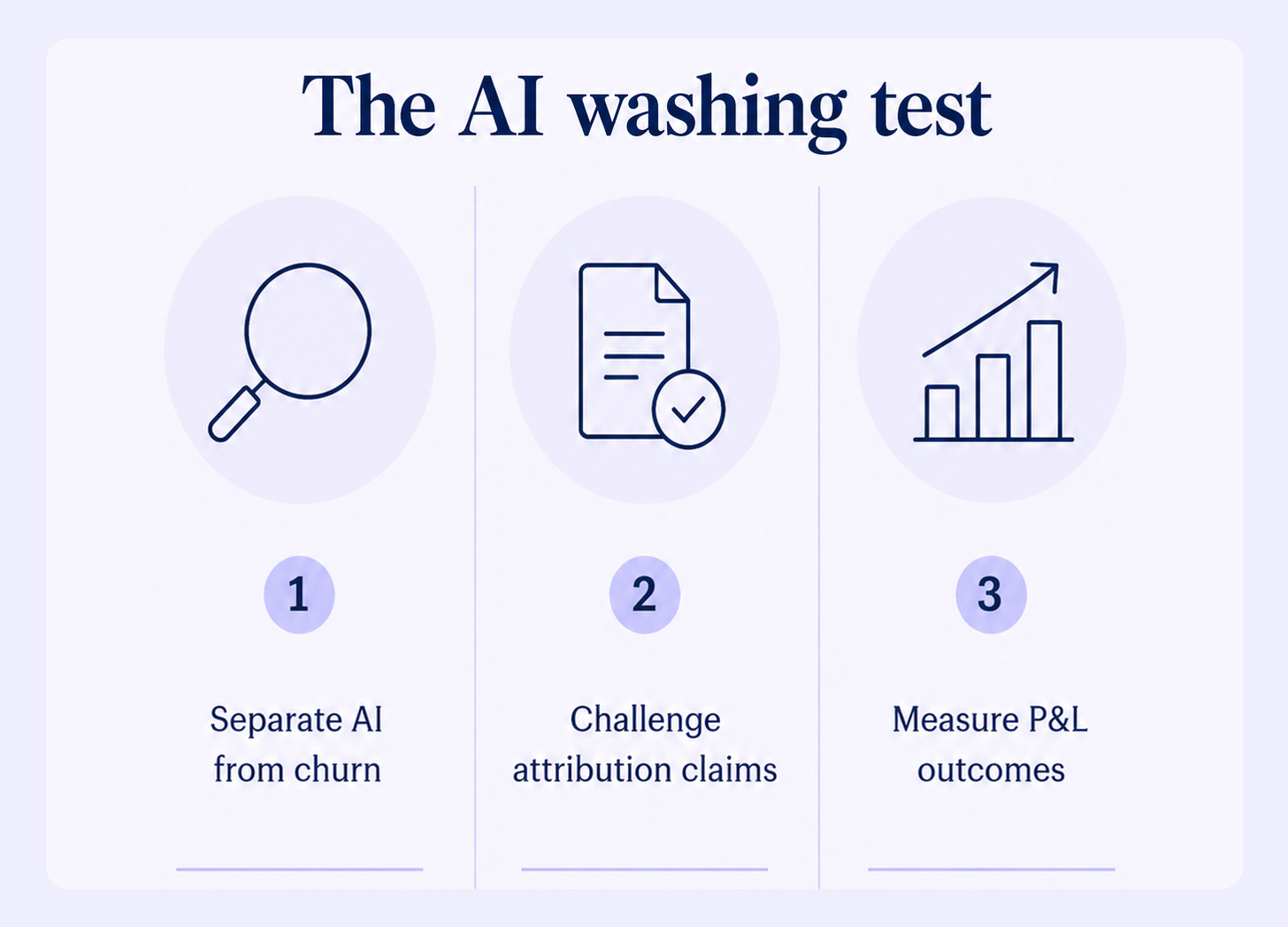
There are several different subtypes of AI washing to consider. These are substitution washing, reallocation washing, bundle washing, denominator washing, forecast washing and vendor washing.