

Hi there,
A few things have happened recently that are relevant to AI transformation and what I’ve been writing in this newsletter.
Australian airline Qantas announced a deal with Accenture that will see it cut 850 roles. They think offshore and automate will work out well for them.
Microsoft suffered an outage that lasted over a day, impacting much of the business and government sector. A material vendor dependency exposed a lot of business continuity and disaster recovery plan gaps around the world.
Both of these give you things to think about in your own business, and how you do an AI transformation.
Part 1: Qantas, Accenture, and AI Job Loss
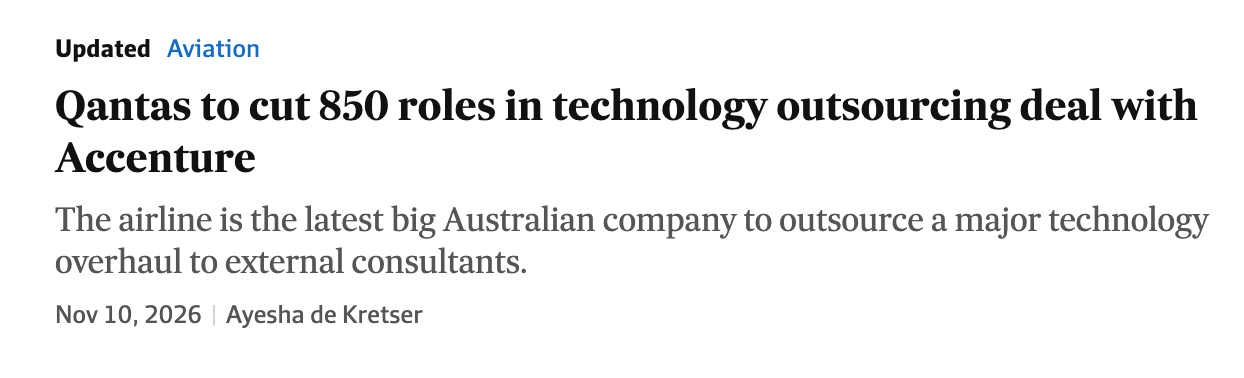
Qantas announced an interesting deal with Accenture that could represent a model that becomes more common as big firms with operating model complexity try and navigate the AI era.
Qantas say they have a legacy stack with over 1,000 applications that weren’t designed to work together. Accenture will make an investment to start modernising that operating model and pick up the outsourced roles in India.
Is this AI or is this just offshoring? Let’s see how the deal evolves and what happens next, but I think it is a sign that many big corporates have done some initial work and realised that to deliver an AI transformation, they need to pay the piper.
If you have over 1,000 applications and you have already been doing cost cutting for years, many of them are likely poorly maintained and rebuilding how everything works will require a lot of management attention.
Qantas are taking the “easy option” here from their leadership’s perspective. It will most likely end up being a disaster. Why? Because the AI era requires leaning in and doing the work.
The reason you end up with internal applications jungles is poor leadership. Doing deals like this is like trying to take a shortcut without thinking carefully about what consistently better, faster and cheaper AI means.
My theory is much of this is because capital markets participants are behind the technology curve. Many will be building their models of Anthropic for the IPO manually in Excel spreadsheets because the regulation and policies around equity research production are not ready for AI-generated work to get past a control room.
This means you have a scenario where people who don’t know much about AI are rewarding people who don’t know much about AI taking common corporate playbook actions that make it look like they’re doing something about AI and automation.
From a customer experience perspective, what will get better under this arrangement? Will there be any operational failures down the track that could have been avoided if a different path was taken?
Simplifying your operating model and leaning into AI requires understanding that control of every +ev thing you can automate with AI is the only way to build a sustainable profitable operating model in the AI era.
This is because the economics of the firm have shifted. Coordination is easier, and a lot of the monitoring costs are lower. A massive outsourced operation with multiple touch points and an estate of 1,000 internal applications is a nightmare waiting to happen.
Human beings like to avoid pain. As I read more of these stories, it’s clear that realising “yeah, this time is different, this playbook won’t work” is escaping many corporate leaders.
That gives business owners and leaders like you an opportunity to differentiate and win in the AI era through doing AI transformation properly.
Part 2: Microsoft Outage With A Claude Chaser
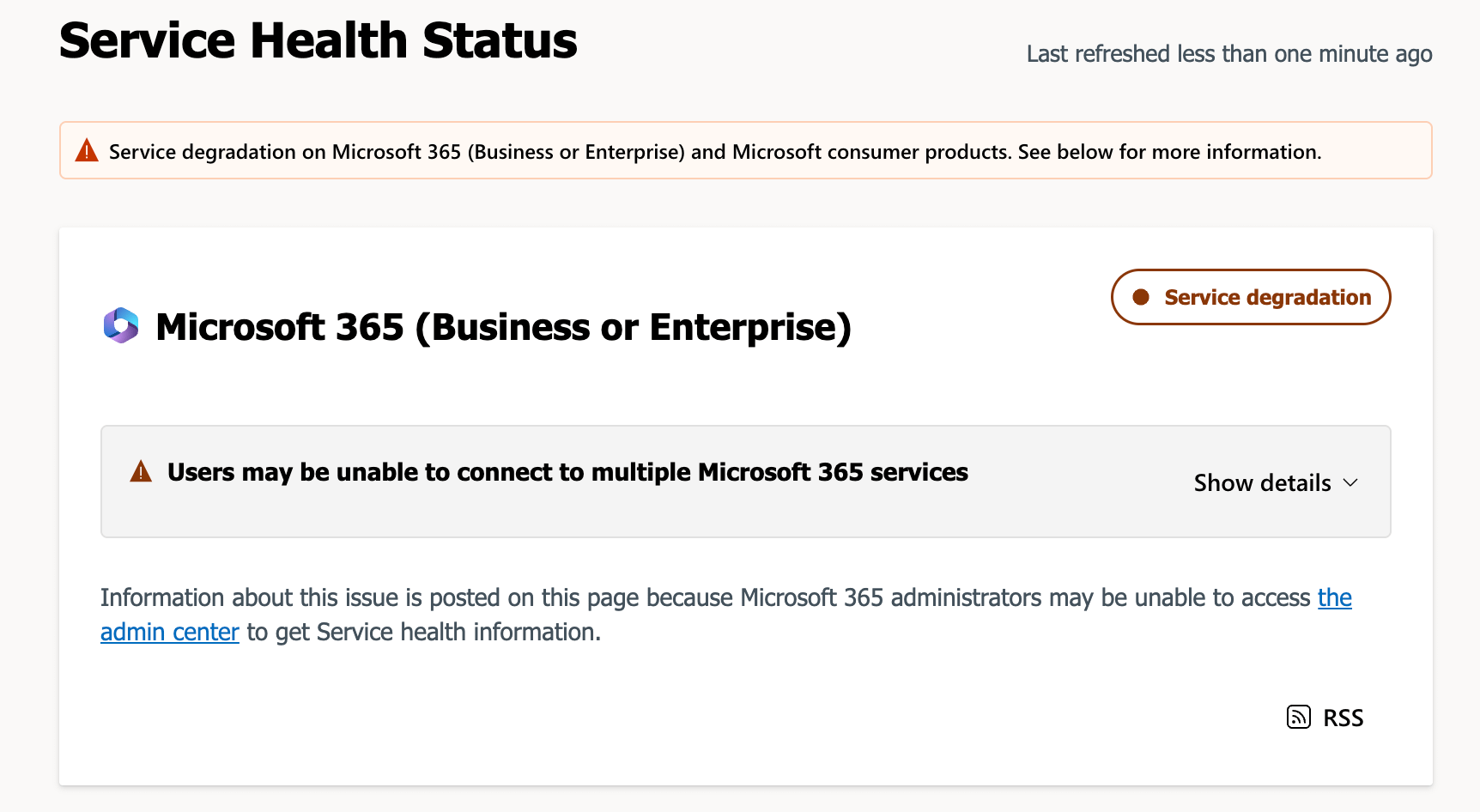
Many people globally were impacted with one of the most puzzling outages in recent memory.
Anthropic, unfortunately in the middle of getting ready for its blockbuster IPO, suffered an issue with Microsoft 365.
The root cause is apparently a flaw in a months-old update to Microsoft’s own gateway servers, which then cascaded through the Microsoft ecosystem.
This had an impact on a lot of companies which had services that were wholly reliant on the Microsoft ecosystem.
My worry is that while there are a lot of things written up in business continuity plans and disaster recovery plans, realistic fallback or alternative options can be expensive.
How many companies would maintain a parallel Google Workspace stack in case there was a Microsoft 365 outage? How many would self-host their email servers or use different tools that have no risk of outage because they are local and not cloud-only?
Later on Friday, I noticed an issue with Claude. Whatever happened with authentication related to Microsoft 365 had worked its way into impacting however Anthropic were doing authentication for some users. I was locked out of my own Anthropic account for a few hours.
This is the reason I’m including this in the newsletter, because I think as we move more workflows to AI, we need to be thinking carefully about where those workflows are living. A wide range of AI models from different vendors, both closed-weight and open-weight, need to be in the mix.
Regulators around the world have already flagged over-dependence on Anthropic or OpenAI as an issue. For smaller businesses where things mightn’t be as mission-critical as a regulated entity, there is some slack you can build into your operating model.
If you have picked Anthropic as your option, you need at least one open-weight model as a backup, and you should test your workflows on these other models to see if you can save money.
Better, faster, and cheaper doesn’t mean picking one model and sending every workflow to it. Judiciously choosing the right model for the right task is partly a science, but partly an art.
When you use AI a lot, you know what the feel of different models is like for different tasks, and you develop your own tastes and preferences. Over the last few years, I’ve developed my own tastes, and worked with people to help get results from AI.
One of the biggest blockers to winning with AI is a lack of willingness to experiment with different model families. Leaders pick Anthropic or pick OpenAI and leave it at that. In the next section I’ll outline steps to take to make your AI-first operating model more resilient.