

Welcome to all new subscribers! This newsletter grows through word of mouth and your referrals, which are much appreciated - if you have found this useful please send it along to a friend or colleague - Brennan
Your team has seen initiatives come and go.
The last reorganisation. The digital transformation programme. The innovation lab that launched with fanfare and quietly closed eighteen months later. They have learned something from these experiences: the rational response to a new priority is to wait. To conserve energy for things that will actually last.
If your AI initiative feels stuck despite training, tools, and clear communication, consider this possibility: your team may not be resisting. They may be reading the room.
This is the failure mode to check when you have shipped access, provided training, and leaders have publicly committed to changing how work gets done. If all that is in place and adoption is still stalling, read on.
The Silent Question
This is the third friction point in the 5C Adoption Friction Model. Where Clarity asks “What exactly am I supposed to do differently?” and Capability asks “Do I know how to do this?”, Credibility asks something more uncomfortable:
“Does leadership actually believe in this?”
Employees ask this question constantly, but rarely out loud. They answer it by watching. Not what leaders say. What leaders do.
Credibility friction shows up as wait-and-see behaviour. People agree in meetings and do nothing afterward. They comply with the minimum requirements. They hedge their effort, unwilling to invest energy in something that might fade in six months.
Here is how this typically plays out. The adoption push is dismissed as “flavour of the month.” From the employee’s perspective, adopting early is a bet. Waiting is a hedge. And most people hedge.
The Visibility Gap
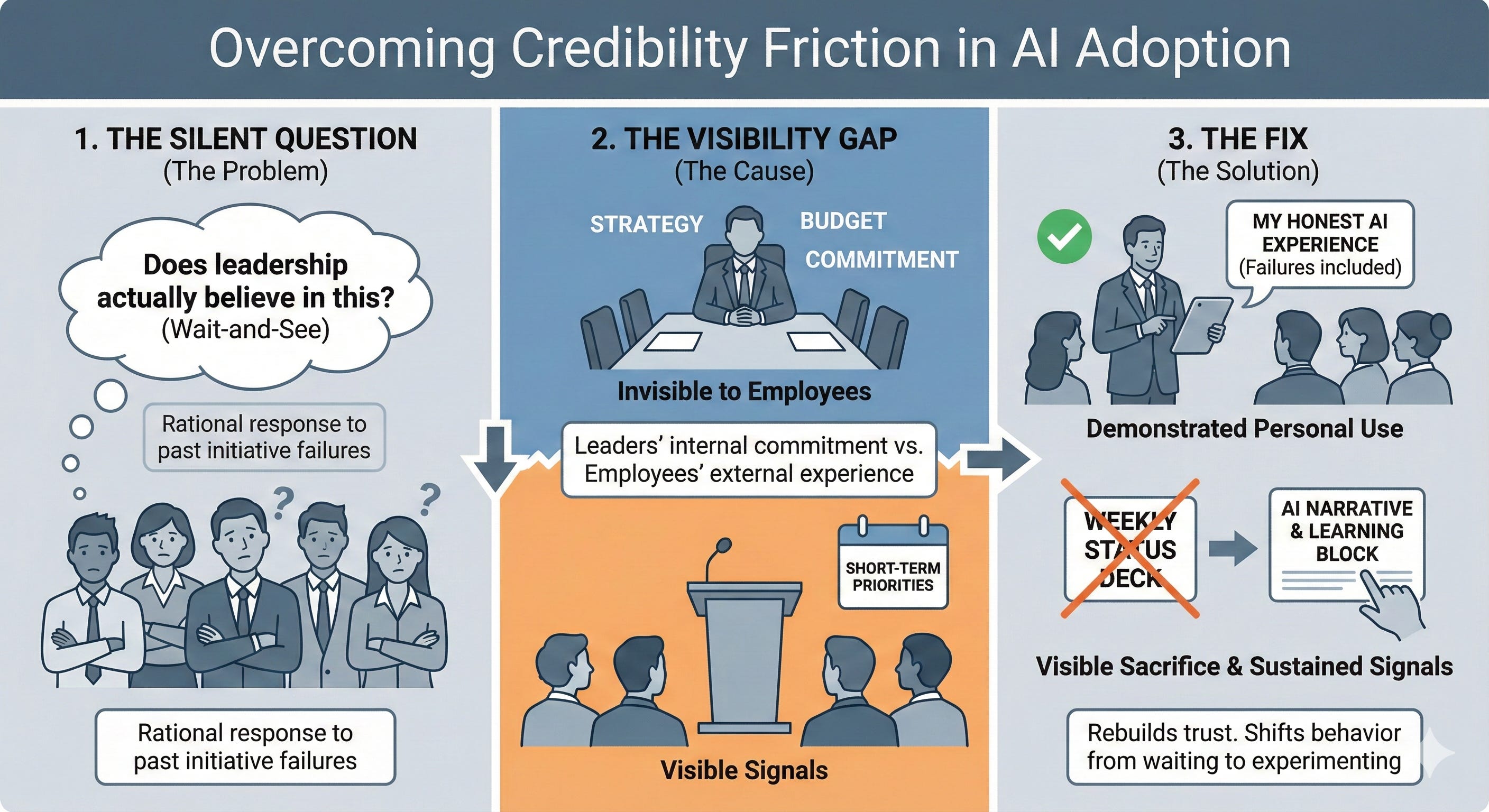
Leaders experience their own commitment from the inside. You know the budget battles you fought. The political capital you spent. The strategy sessions where this was debated and decided.
Employees experience your commitment from the outside. They see town halls where AI is mentioned but never demonstrated, mandates for others without visible adoption by the people making the mandates, and short-term priorities consistently winning when they conflict with the AI initiative.
This is the visibility gap. Commitment that happens in strategy sessions and budget meetings is invisible to the people whose behaviour needs to change.
The uncomfortable truth is this: if your team is waiting you out, the signal they are reading is coming from you. Not from the strategy. Not from the tools. From what you do and do not do, every day, in plain sight.
If prior initiatives faded, waiting is self-protection. Colleagues who adopted early ended up in the same place as those who waited. The calculation is rational.
If you have already invested in leadership communications, the question is not whether leaders have talked about AI. It is whether they have shared specific, honest accounts of their own use. Many organisations have the former. Few have the latter.
Endorsement sounds like: “AI is transforming our industry and we need to embrace this opportunity.”
Experience sounds like: “I used an AI assistant to draft the board update. The first version missed the tone completely, so I refined my instructions and added context about the audience. The second pass was clearer than my usual first draft, and it took half the time.”
People can dismiss endorsement as corporate messaging. Specific, honest accounts of personal use are harder to dismiss. The gap between announcing commitment and demonstrating it is where credibility dies.
Is It Actually Credibility?
Before assuming Credibility is your primary blocker, check the alternatives.
If people do not know what they are supposed to do differently, that is Clarity. The question “What should I use this for?” indicates confusion about the task, not doubt about leadership commitment.
If people are trying and failing, that is Capability. You hear noise: frustrated attempts, outputs that miss the mark. Capability problems show effort without success. Credibility problems show reluctance to make effort at all.
If there is no downside to ignoring the initiative, that may be Consequences. People might believe leadership is committed and still wait, if waiting has no cost.
And if legal policy blocks real use cases, or the tools genuinely do not fit the workflow, that is a constraint problem, not a credibility problem. Credibility is the blocker when the path is clear but people do not believe it is worth walking.
If you suspect Credibility is the issue, the evidence will not come from your dashboards. It will come from what your team observes.
Three Diagnostic Questions
The question to ask yourself is this: How would you know if Credibility were your problem?
1. The sacrifice test. What have you personally given up to make this work? Not approved. Given up. If nothing comes to mind, your team already knows.
2. The evidence test. If someone on your team called this initiative “flavour of the month,” what evidence would they cite? If they can list specific examples, you have a credibility problem.
3. The visibility test. Can employees name a leader who uses AI tools weekly and has shared what they learned? Not endorsed. Used. If not, leadership commitment is invisible.
If you struggle to answer these, Credibility is likely a significant friction point.

The Fix
The fix is not better communication. If the problem is that people do not trust words, more words will not help.
Let me be direct about what actually works. Three elements matter.
Personal use, not just endorsement. Leaders must use the tools themselves, visibly. Not delegate experimentation to innovation teams or junior staff. Use the tools in their own work and talk about the experience honestly, including what did not work.
Sustained signals, not one-off actions. One visible action creates momentary credibility. Without repetition, people assume it was performative. Monthly is better than once. A standing segment in leadership communications where someone shares what they learned builds a pattern that cannot be dismissed.
Sacrifice, not addition. This is the element most leaders miss. Credibility is not built by adding AI to everything else. It is built by choosing AI over something else.
Here is what sacrifice looks like in practice:
Cut the weekly status deck from twelve slides to five and replace the rest with an AI-generated narrative.
Stop an internal initiative and reassign the owner to AI enablement.
Delay a deliverable to protect the team’s learning block. Own the conversation with the stakeholder.
If leadership has not given something up, the organisation notices. And they draw the logical conclusion about how serious this priority actually is.
One Thing You Can Do This Week
If you do nothing else: share one honest account of your own AI use with your team. Not a success story. A real experience.
“I tried using an AI assistant to prepare for the client meeting. The first attempt was too generic. I had to refine the prompt twice before it gave me something useful. But it surfaced a risk I had not considered.”
That is the smallest unit of demonstrated commitment. It costs nothing but honesty. And it signals something that no amount of strategic communication can: that you are actually using the tools you are asking others to adopt.
What Success Looks Like
When credibility is rebuilt, wait-and-see behaviour shifts to experimentation. People stop asking “Will this last?” and start asking “How do I do this better?” Cynicism fades. Discretionary effort appears.
The initiative stops feeling like a programme and starts feeling like how work is done.
That shift does not happen through communication. It happens through demonstrated commitment, sustained over time. There are no shortcuts. But every honest account of personal use, every protected learning block, every visible sacrifice adds to the pattern that eventually becomes undeniable.
If this does not change, adoption will remain stuck. The budget will be spent. The initiative will quietly wind down or be absorbed into the next priority. And the next transformation you try to lead will be harder, because your team will remember this one.
The hardest part of a credibility problem is that you cannot see it from inside. You experience your own commitment. Your team experiences your behaviour. The gap between the two is invisible to you by definition.
The Credibility Playbook, available to paid subscribers, goes deeper: the full five-question diagnostic, worked examples of visible actions across different levels of your organisation, and a template for sustained signals that survive quarterly priority churn.
For hands-on support diagnosing which friction point is primary in your organisation, book the AI Change Leadership Intensive.
Next week: Control. “Will this make me less valuable?” The friction point that hides beneath the surface.