

Hi there,
If you’re new here, I’m Brennan McDonald and I write about the people side of AI transformation. This newsletter grows through word of mouth and your recommendations. If you enjoy this, share it with a friend today. It’s always appreciated. If you have any feedback for me, you can reply to this email.
- Brennan
In today’s newsletter:
Everyone is being asked for an AI story
What AI does to the work you already do
Where AI change comes unstuck
Where to start, and what to do next
Everyone is being asked for an AI story
All your stakeholders have an opinion about AI. Give everyone access to Claude, get a consulting firm in to map out all of your existing processes, outsource your operations overseas, or vibe code a new CRM.
In 2026, you definitely need an AI story. It can’t be about what other people are doing. It has to be what suits you and your business and the industry you operate in, inside all of the regulatory constraints and industry practices you have to get right.
There’s a gap between what you’re doing today and what is possible with the help of AI. I often see comments like “I can’t think of ways to use AI in my business” or the like.
This sort of thinking is a tragedy. If you’re struggling to come up with use cases, all you need to do is turn on the voice command. Dictate into your favourite AI tool, tell it about your business and ask about basic use cases.
It really is that simple. For example, one client did not know how to connect one application with another. They were still copying and pasting. It turns out all they needed to do was ask for developer access, get given an API key, and then suddenly they could easily query and access their data which had previously been locked up.
There are efficiencies lying on the floor in every business in the world at the moment. A lot of hardworking and clever business owners just don’t have the time to even think about which questions will get the most out of an AI agent if they want it to partner with them.
AI is a people problem, not a technology problem. What this means is that if we’re leaders and we’re business owners, we can’t just delegate and outsource the thinking around what AI change needs to look like in our business. We need to put in the work.
The risk when you have the pressure to tell a story about how you’re using AI in your business is that you fall prey to what I’ve called cosmetic AI. Everyone gets a ChatGPT Enterprise licence.
Maybe you put in some workflows which reduce manual effort on repetitive tasks. You might even connect system one to system two, which means you don’t need a team which used to manually reconcile the two anymore. A lot of this stuff could have been done even before the AI era.
I think a lot of this AI washing is partly people finally realising maybe we could use technology to help us solve problems. The intelligent firm is somewhere a lot of companies are quite far from on their journey.
They need to do a lot of deep thinking about their operating model as it stands today and where it could be with the fullest application of the multiplier effect of AI before they are in a position to really break through.
What is your AI story going to be if vast parts of your operating model as they stand today have no reason to exist in the AI era?
What AI does to the work you already do
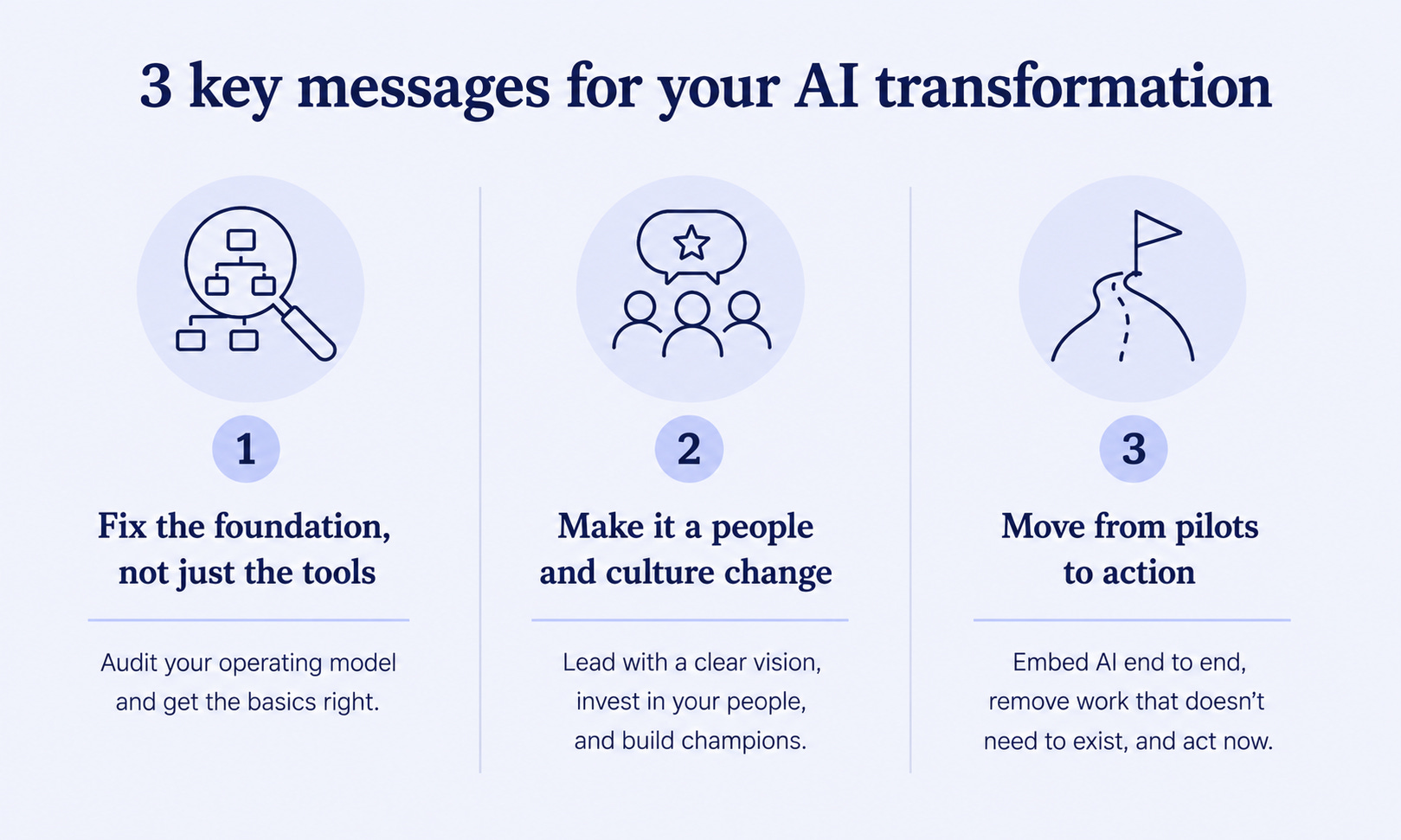
An operating model is people, processes and platforms. As we move into the AI era, firms where more of the thinking and execution is done by AI agents are building on top of the foundations of what has gone before.
If you remember the cloud migration era, there were two ways that businesses dealt with this. The first approach was called lift and shift, where you’d take an application and just deploy it in the cloud with limited reflection on what refactoring or redesign was required to optimise things like cost, security and efficiency.
The second was by doing a process to make what was being deployed to the cloud more suitable. This involved reflecting on the overall architecture of the business to make sure that you didn’t have absurd situations that existed in on-premise data centres being perpetuated into the cloud era.
For those of you who’ve worked on projects like this, yes, I’m simplifying. For the purposes of this general business audience, I think it is a fair reflection of what the two main approaches were.
The first approach of lift and shift led to outcomes like security breaches. Bill shock. And a level of complexity which did not use a lot of the native functions of the cloud platforms like AWS.
The second approach of redesign led to some of the first movers achieving much more efficient and cost-effective operating models. These were not only more resilient, but were in a position to take advantage of all the incremental additions to cloud platform functionality as they were introduced.
We can think of AI as a multiplier on the operating model you already have today. You already have strengths and weaknesses, where the problems are in your business, and where the pain points are.
You need to be open with yourself if you’re thinking about AI transformation in your business. If you have a weakness, maybe you never put enough into cybersecurity, or maybe you never put enough into data governance and data quality.
If your operating model is already this brittle, AI will widen every crack you have been ignoring. Where to start matters more than which tool you pick.